Indian Embroidery

I found Lakshmi Sadala’s very cool blog when she commented on one of my posts. I’ve linked all the photos in this post to the original posts on her blog, so you can just click and go look. I absolutely love these network flowers!

The flowers below are the chemanthi stitch. As well as a few posts with beautiful embroideries, there’s a Chemanthi stitch tutorial post so you can do it yourself.

There’s an enormous variety of embroidery on her blog – some Indian, some not, and all kinds of creative experiments with stitching. She has a variety of written and video tutorials, and lots of links to other Indian embroidery blogs. I’ve been desperately trying to read all of it but there’s so much it’s going to take a few more weeks. It’s really incredible!

The picture to the right is from a tutorial on attaching square mirrors to your embroidery with a beautiful net effect. Below is a creative use of herringbone that I really like.
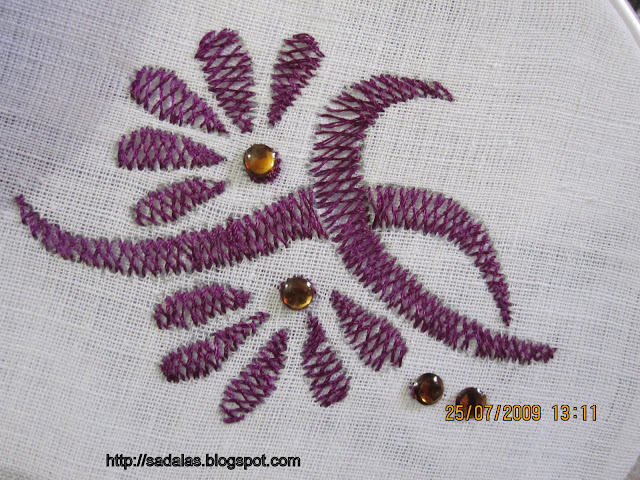
I had a hard time deciding what to feature here! Anyway, here is one more design in fly stitch and lazy daisies:

Posted in Embroidery around the world, Free resources online, Indian embroidery, Surface embroidery, tutorials | Tagged , | 9 Comments

Hmong embroidery II: Chain stitch and mirrors

Update: This seems to actually be Indian embroidery. See this post on Indian embroidery for more information.

In my last post on Hmong embroidery, I promised to show you more Hmong embroidery pieces. And here is another one! This is very different, both in stitching and overall design, from the geometric cross-stitch work. As you can see in the closeup below, it’s almost entirely very tiny chain stitching. While I’ve certainly seen chain stitch used to outline shapes, and even chain stitch used in rows to fill long skinny kinds of shapes, this is the first time I’ve seen it used in spirals to fill lots of different shapes.

Here is another closeup so you can see the other major feature of these embroideries: shisha mirrors. They really make the embroidery sparkle.

If y’all take a look at the full embroidery below, it’s very geometric. There are basically three main stylized motifs – flower, elephant, and peacock, arranged in concentric circles with fancy borders. You could get spectacularly different effects by simply swapping out the petal shapes on the flower, or changing the border stitching of the circles, or by swapping the elephants and peacocks with another animal, plant, shape, even lettering or monograms. Because it is very stylized, it does not require “realistic” drawings of elephants or careful shading. It’s an incredibly versatile design.

There are five colors here – red, yellow, green, white and black. Black and white are neutral colors. In this piece, the black background makes the red/yellow/green pop out, and the white serves as an accent and contrast to the black. If you swap out the red/yellow/green, you will get different effects depending on the proportion of warm to cool colors. This design would look very different if, for instance, the main colors were blue and purple instead of red and yellow.

Posted in Embroidery around the world, Indian embroidery, Surface embroidery | 4 Comments

Hmong embroidery I: Geometric cross-stitch

Today I have two embroidery pieces to share, both very detailed geometric cross-stitch designs. My parents bought these in Thailand at the Chiang Mai Night Market in the mid-eighties (they had an awful lot of fun in the mid-eighties, as you can tell by my Around the World series of posts). They could only tell me that these were made by one of the hill tribes, but not which one.

As it turns out, I visited Saint Paul, Minnesota recently, which has a very large population of Hmong Americans. The Hmong are a hill tribe from Laos, and fought on the American side during the Vietnam war. After the war, many ended up in refugee camps in Thailand, and some have managed to reach the US. They often have the most incredible hair-raising tales of how they made it through to America.

Anyway, I took these along and wandered around Hmong Village, which is an indoor marketplace with lots of small shops and a food court. A number of the shops feature Hmong hand embroidery – the traditional Hmong embroidered dresses are really beautiful! And I love the ones that are a blend of traditional and American styles.  I have just got to think of somewhere I could wear one. So I asked them about these pieces (and a few more, done in different styles, that will be turning up in future posts!) and it turns out that they are in fact Hmong embroidery. It’s a small world. I should also mention the food court is really delicious – especially the fish.

I’ve been thinking a lot about the colors and the designs in Hmong embroidery, and how they differ from traditional western patterns. But that’s a future post.

Posted in Cross-stitch, Embroidery around the world | Tagged , , , , , , , , | 6 Comments

Colcha embroidery

Recently I discovered another style of embroidery: Colcha embroidery is a traditional New Mexican wool-on-wool embroidery using the colcha stitch. It dates to the Spanish colonial era (colcha is also Spanish for quilt). When I investigated further, I discovered the work of colcha artist Julia Gomez of Santa Fe, New Mexico, USA (left, standing in front of her work).

Colcha stitch is done with two strands of wool, irregularly couched down. Ms. Gomez’s What is Colcha? page says “The colcha stitch is a long stitch caught in the middle by a short diagonal stitch. It is a yarn saving stitch, very little yarn shows on the bottom of the cloth. No knots are used on the surface or underside of the fabric.”

This produces an interesting, almost woven texture, as you can see in the closeup of her colcha work to the right. Needlework Tips and Techniques has an article on it, including stitch diagrams (I found it through I Am Not a Handbag’s story of learning colcha).

As described in her What is Colcha? page, Ms. Gomez both spins her own thread from churro wool and weaves the fabric for her work (a textile called Sabanilla). The morning glory below is hers, and is from a short article about her artwork and teaching. I have also included a photo of someone working with colcha stitch:

Finally, here are two more pictures of colcha work (from the Museum of New Mexico and the Española Valley Fiber Arts Center):

Posted in Colcha embroidery, Embroidery around the world, Free resources online, Surface embroidery, tutorials | Tagged , , , , | 24 Comments

O Canada

I was thinking. My philosophy of embroidery is: I know how to doggie paddle so why not jump in the deep end? Sink or swim, y’all! If I get stuck then I desperately hope that Needle ‘n Thread can bail me out. I’ve been throwing up some real exciting drawn thread and hardanger recently, but perhaps some of y’all prefer a more structured approach.

To that end, I’d like to mention a Canadian site, The Victoria Sampler. They have a wealth of resources to support folks trying to learn, including cyberclasses, stitcheramas (live webcast classes), online stitching chat groups, several learning kit series, a few nice animations demonstrating hardanger stitches, several dozen free patterns, and a number of gorgeous advanced designs. There’s a free stitch-your-own-nametag cyberclass if you want to try it out.

The Beyond Cross-Stitch Learning Collection has 6 levels containing 10 small kits each (costing around $10 USA including all materials). I’m including one picture from each level.

The kits each add a single new stitch technique and include stitches from previous levels. The levels cover the following topics:

  1. Specialty stitches
  2. Silk ribbon stitches
  3. Counted stitches and techniques
  4. Drawn thread, pulled thread, and hemstitching
  5. Beginner Hardanger
  6. Intermediate Hardanger

The Beautiful Finishing series covers how to finish for display your needlework in the form of bellpulls, ornaments, biscornus, boxes, and other items.

They have a variety of designs that are not in the learning series; they have many styles (samplers, ornaments, biscornus, etc), but here is my favorite trio (all of which have pattern packs, thread/accessory packs, and cyberclasses available).

You can order online or they have a shop finder to help you locate needlework shops near you that carry these (they distribute to all over the world).

Posted in Cross-stitch, Design sites, Drawn thread, Hardanger, Surface embroidery | Tagged , , , , , , , | 1 Comment

Drawn thread embroidery

Today I found you a (free!) beautiful 19 page tutorial on drawn thread work from the Heritage Shoppe. This shows you, in detail with many photos,  how to do the work in this picture. It’s a type of embroidery where you cut some of the threads, pull them out, then decoratively embroider the remainder. Looks fancy, doesn’t it? It has three stages of increasing complexity, but keep in mind you don’t have to do all three at once. You can just do one of these, either as an accent to another style of embroidery or as a border. I suspect that if you have a background in tatting or crocheted doilies, the experience will make the work easier.

Now, perhaps you’d like some ideas for incorporating this into designs: UK designer Christine Wilkins of Alchemy Stitchcraft has some interesting kits with icicles and kites (and many other designs using cross-stitch, hardanger, pulled and drawn threadwork, and beads). I’ve linked the pictures to the kit description, so if you click it’ll take you there.

The Heritage Shoppe also has a free 170 page introduction to embroidery, short essays on various embroidery topics (fabric and weaves, thread terms, descriptions of some embroidery styles, etc), and some discussions/tutorials of various stitches such as laid work, bullion stitch, shadow work, and Romanian couching, among others.

Just so y’all are clear: these posts are not sponsored – I am not getting paid by the kit companies. These are just companies I saw and liked.

Posted in Design sites, Drawn thread, Free resources online, Hardanger, tutorials | Tagged , , , , , , , , , | 5 Comments

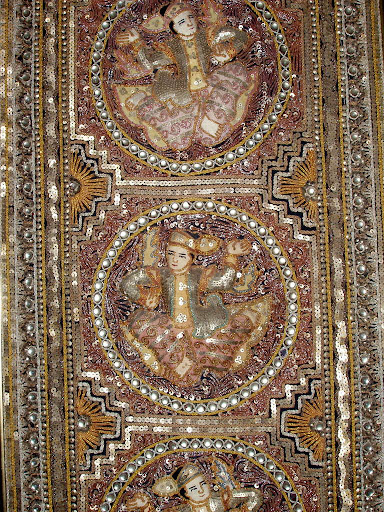
Kalaga: Burmese angels dancing

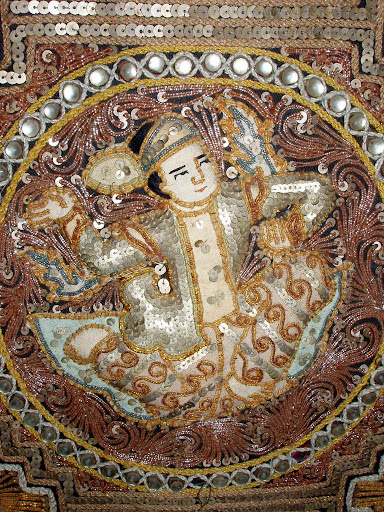
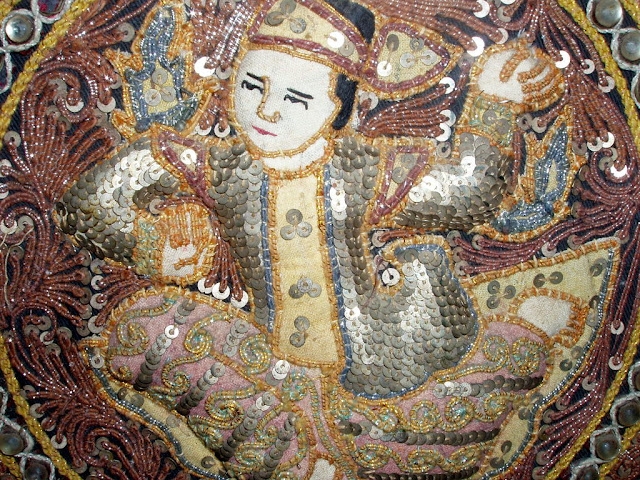
This is a kalaga, from Burma (Myanmar), which my parents bought in the mid-eighties. Traditionally, there are padded figures in the middle, and they are heavily embroidered with sequins and other decorations. In this piece, the figures are five dancing angels. This type of design with angels is traditionally used for funeral services as a coffin drape. Since it’s so beautiful and Americans are usually clueless it’s displayed on the living room wall. My mother says her Thai friends were shocked, and considered the decor scheme very Goth.

Here are closeups of two of the angels. The design incorporates a lot of sequins and beads, and the rest is mostly couched braids/cords. The angels are very heavily padded.

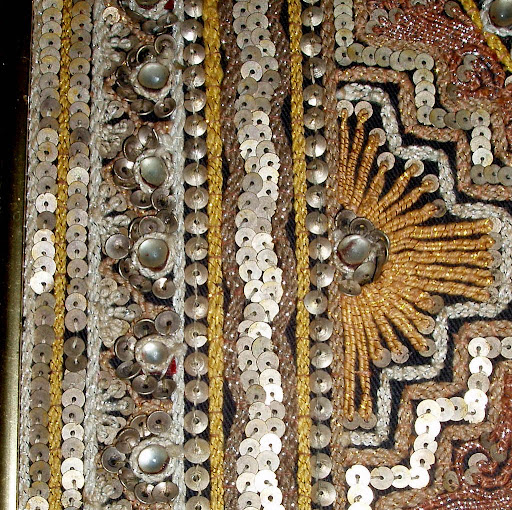
I’ve included a closeup of the border design. It’s really amazing what you can do with sequins. The kalaga is such incredibly detailed work, on such a large scale.

Posted in Bead embroidery, Embroidery around the world | Tagged , , , , , | 6 Comments

Portfolio of Designs for Embroidery

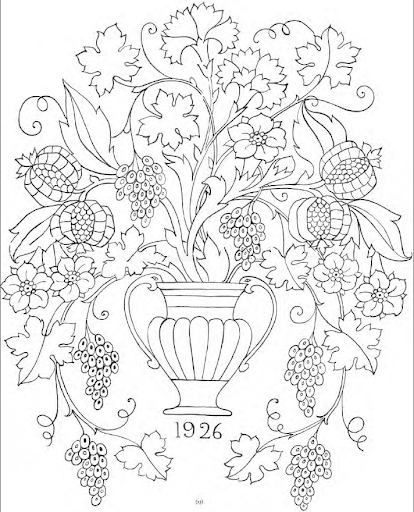
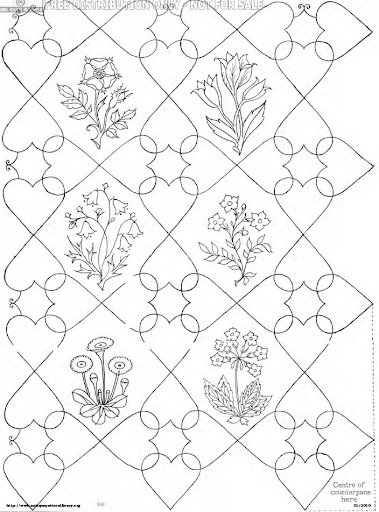
The Antique Pattern Library strikes again: This is a free 1929 pamphlet by Joan Drew, which consists of a 1 page introduction and 16 pages of nothing but design outlines. The contents are mostly flowering plants and birds, in a variety of design sizes and design types (small flower sprays, full vases, birds sitting on a twig, birds in a tree, borders, corners, etc). Here is the link directly to the pdf for Portfolio of Designs for Embroidery.

Posted in Free resources online, Historical, patterns and designs | Tagged , , , , | 6 Comments

Talliaferro Designs

I am very very excited to announce that I found a brand new line of crewel embroidery designs by Anna Garris Goiser from Virginia (USA)! So brand new that the chartpacks are in fact being written right now. The Royal Persian Blossom to the left will be the first design released by Talliaferro Designs sometime this spring. Isn’t it great?

There are 15 designs, all beautiful, in a variety of styles, so you should go look. They will all be turned into chartpacks/kits, and on the website Anna asks for feedback on what order to develop the patterns. So if you have a favorite, you may be able to influence when it comes out. Furthermore, she provides an example layout of a design and instructions and says “We invite you to take a look at them and let us know any suggestions you might have for making them better and easier to use.” If there’s something you always want to see in crewel instructions, or something that drives you nuts and you never want to see again, now is your chance. I emailed her and she sent a lovely reply.

There’s also a nice introduction to crewel embroidery. It’s a great website all around.

Posted in Crewel, Design sites | Tagged , , , | 5 Comments

Hardanger

This is a type of Norwegian embroidery, popular also in the northern midwest USA. It’s very geometric with lots of square eyelets and lacy fillings. Nordic Needle’s specialty is hardanger, and they provide an extensive overview of the topic, lots of designs for sale, and some free patterns. What’s more, there is a full series of free lessons: 101, 201, 301, 401, and Weaving.

Now that we are all experts in hardanger, I am declaring the following two designs the coolest hardanger I can find on the internet. If you find something even better, I’d really love to hear about it.

Offbeat Hardanger: I have the instructions for this one, designed by Jonalene T. Gutwein at Friends in Needlework, and I am definitely going to make it (or maybe a portion of it since I’m super busy – it really divides up well. Even a quarter of it would look good).

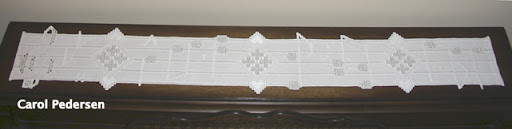
Carol Pedersen has designs available through Nordic Needle, like Birdsong, a musical design that is rather larger than I want to attempt (but maybe I could just do a few notes from it!).

Posted in Design sites, Free resources online, Hardanger, tutorials | Tagged , , , , , , | 1 Comment