I thought I’d mention some kits that caught my eye the other day. These are combination cross-stitch center/blackwork frame designs of wildlife from Rose Swalwell of Derwentwater Designs (couldn’t find the designer homepage, so I picked a shop). In the Bird Brocade design I’ve been working, the central bird stands out in wool against a floss background. These designs draw attention to the central figure by switching embroidery techniques. They’re a little too much cross stitch for me, but I really like the idea of using a change in style to create contrast in the design.
Anyway, I think they’re really cute (and there’s three more: owl, hare, and deer), and perhaps some of y’all like cross-stitch. I haven’t seen anything like it here in the States.
I’ve been reading about Armenian embroidery! The examples on this particular site are all based on complex interlacings of variations on the herringbone stitch. This results in somewhat stylized geometric designs, like the embroidered cross in the photo to the left. The cross is an Armenian cross (notice the eight points), and the eight-pointed star is also an Armenian symbol. The site says this relates to the eight points of the compass. The pillowcase below is from their gallery of Armenian work.
I don’t know if I want to do an entire embroidery in this stitch, but I absolutely love these borders.
The site also has detailed instructions and diagrams for the embroidery. Two basic stitches are introduced, then on a separate advanced page they provide sixteen motifs and borders with diagrams to explain the steps. The diagram to the left is the final step of one of the motifs on the advanced page. Below is an excerpt of one of the diagrams from the basic tutorial:
Finally, this is an excerpt of one of the borders discussed in the advanced page:
While looking at Italian embroidery the other day, I discovered Tutto Ricamo, which is an Italian site (available in both English and Italian) with a huge amount of information on Italian embroidery history, types of embroidery, a number of tutorials for Italian Needlework, and a video tutorial library. I had no idea there were so many kinds of embroidery in Italy! I will give a few examples below, but you should go look – there’s so many amazing pictures there.
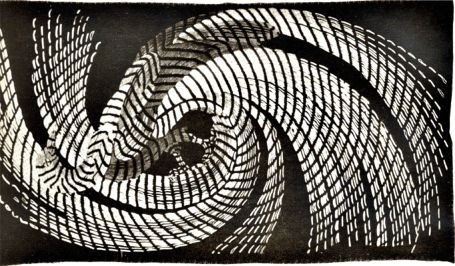
Lampugnani embroidery is an Italian technique invented by Teresita Lampugnani of Novara in the 1920s, which reminds me of Kantha embroidery because it’s done entirely in running stitches. The picture to the left is the Silver Pheasant, one of her most significant works. Tutto Ricamo explains how to make it.
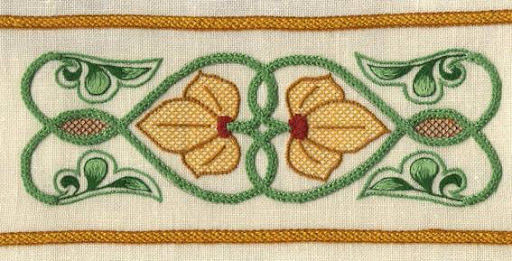
Estense embroidery is a lovely embroidery inspired by designs on Graffito ceramics in Ferraro, Italy. There’s a tutorial on bilateral pekinese stitch for the bands:
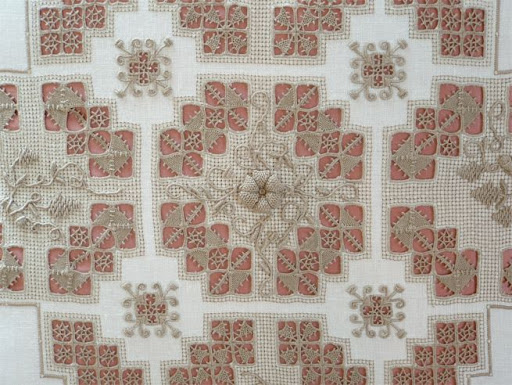
Today I’m just going to point y’all to Italian Needlecrafts, which (in addition to selling Italian needlework supplies) has available free scans of a number of editions of two magazines from the early 1900s: Il Ricamo Illustrato and Il Ricamo. They contain all kinds of embroidery (cutwork, surface embroidery, drawn thread, cross-stitch, and more). I think the cutwork below is my favorite pattern from the magazines (it’s such an unusual subject for cutwork).
Tuesday there were lots of people talking about the Japanese Festival of Needles (on stitchin fingers). So I thought I’d write about my experience with Japanese embroidery when I visited Kyoto. A few blocks from where we were staying, there was a tiny embroidery shop with two small rooms (it was hard to spot, because it only had a single small sign in the window). My aunt is Japanese, so she translated for us. The shop owner is the lady in the pictures in this post, and embroidery runs in her family. Her brother is a National Living Treasure of Japan in honor of his embroidery work. We saw her in-progress work (and the work of a student there for a private lesson), and both pieces were incredibly beautiful and perfect silk work. Then she showed us a commissioned project worked in black lacquer thread. She is an incredibly friendly, kind woman and was delighted to see people taking an interest in embroidery. In fact, she gave my mother as a gift two traditional Japanese needles and a pincushion. Apparently, the big needle is used like a laying tool, to make sure your satin stitches lay smoothly. She gave us a demonstration and some tips. My mother bought the Japanese silk in the photo in this post (the shop owner says most silks in Japan are Chinese but these are genuinely Japanese). I’m afraid I have no photos from the shop, but I have a pamphlet she gave us, and the photos here are her work.
I seem to have plenty of crewel embroidery fans reading my blog, so I will mention two more companies from the other side of the world, in case y’all don’t know about them. Here are three designs from Cindy Cooper in Australia (Bellpull, Temptations, and Pink Rainbow):
She’s such a talented designer. I could look at her work all day long. I had a hard time picking just three to post here.
And here are three designs from Daaft Designs in South Africa, which has really interesting crewel designs in a distinct style (I have linked the photos directly to the Jacobean embroidery designs section of their website):
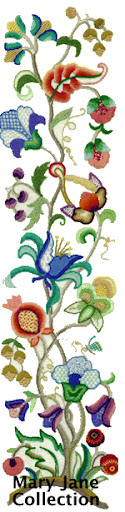
This is the Plas Teg Bellpull from the Mary Jane Collection (2 feet by 6 inches).
I’ve had this for a while. I was so excited about this design that I went and got the floss for it, even though I cannot possibly start it until I finish some (many) projects. I can pull it out and look at it though. It also has a color list for Caron Impressions wool/silk blend, but I can’t afford that, and it’ll be beautiful regardless. I should note that I changed the colors slightly – I chose a bolder shade for almost every color. I like very bright colors.
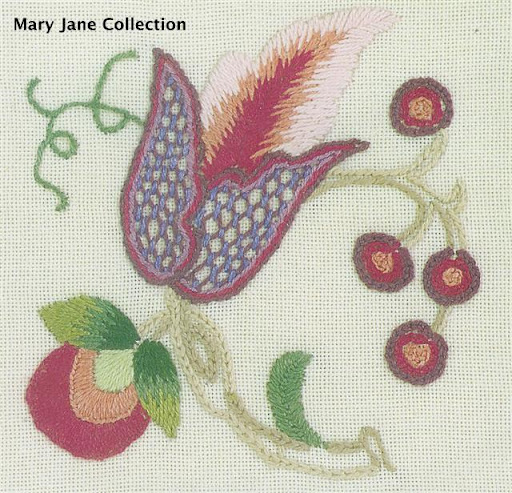
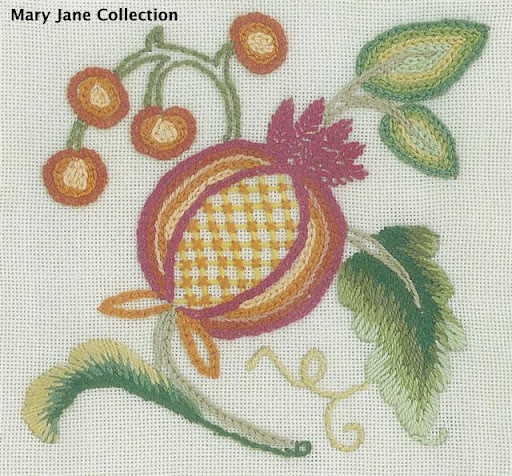
I mentioned the Mary Jane Collection’s goldwork in a previous post, and their crewel designs are just as amazing. The Plas Teg bellpull is one of four bellpull designs. They also have a range of 5×7 inch kits, a range of 4.5 inch square tiles, and a few other designs of varying size. The two smaller kits pictured here are the 4.5 square tile size. It’s a UK company, but US folks can find some of their kits and chartpacks at Stitchers’ Paradise or Needlework Corner.
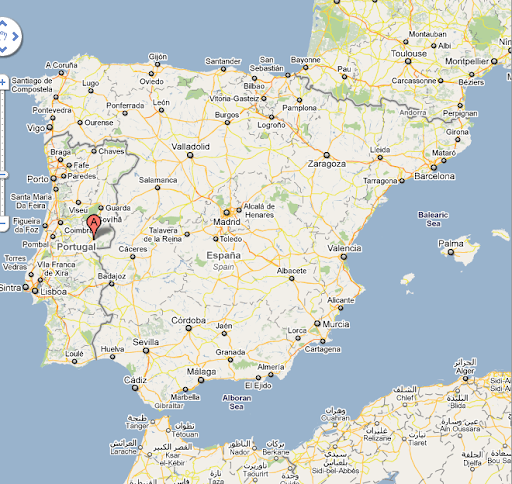
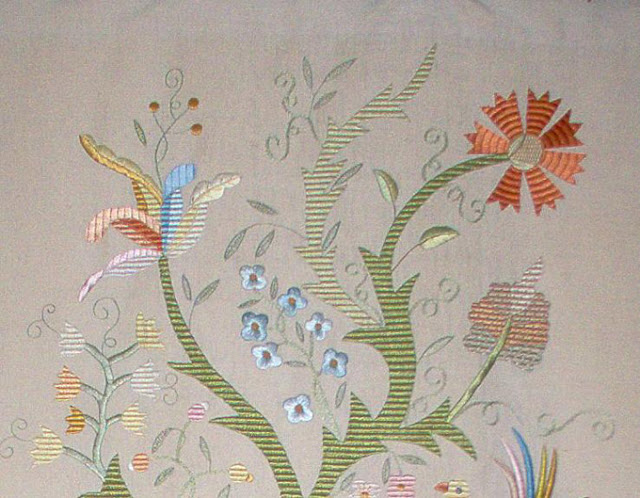
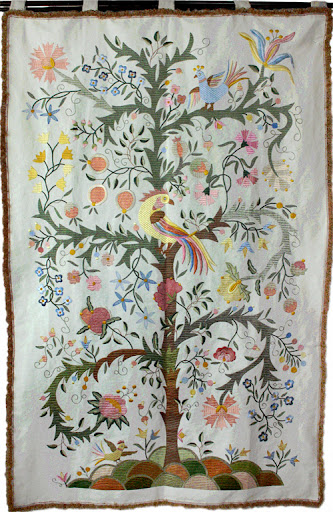
Méri kindly posted a very informative comment on my post about colcha embroidery. It turns out that “colcha” means bedspread in both Spanish and Portuguese. Furthermore, there is a traditional Portuguese style of embroidery which uses a similar stitch to embroider bedspreads (although in linen and silk instead of wool from New Mexican sheep). This style is called Castelo Branco (White Castle) embroidery/stitch, named after a region in Portugal, or sometimes frouxo (loose) embroidery/stitch.
Like the colcha stitch, the frouxo stitch only covers the front of the fabric and barely shows on the back. I am still working on finding a stitch diagram, though Méri tells me it is not identical to colcha stitch. But below is a video of three ladies stitching while being interviewed by a TV show (all in Portuguese. I can’t follow what they’re saying, but the embroidery is beautiful). I think the strange “old lady” towards the end is for comic relief? It’s hard to tell when you don’t understand the language!
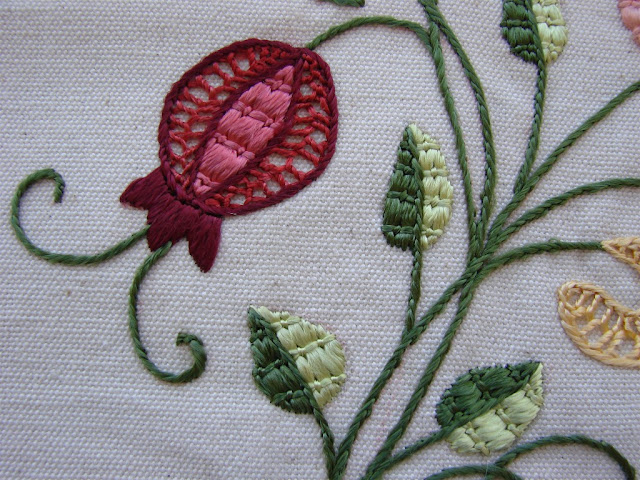
Here is a closeup (of a lily and carnation, symbols of a man and a woman) from the website of M. Fátima Paixão (english translation) about Castelo Branco embroidery:
The designs are extremely symbolic, but the websites don’t entirely agree on which symbol means what. Here is a sample set of definitions:
two-headed bird – two souls in one body, married couple
carnation – man, rose – woman
lilies – virtue, virginity
ivy – strong affection
rooster – virility
pomegranates and pinecones – the unity of the family
jasmine – chastity,
linked chain – indestructible marriage
tendrils – friendship.
I found a few other sources of information and photos of Castelo Branco embroidery, which you can take a look at if you are still curious:
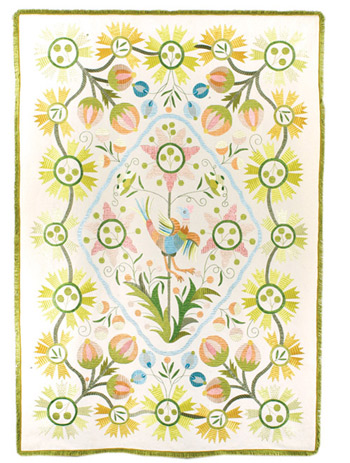
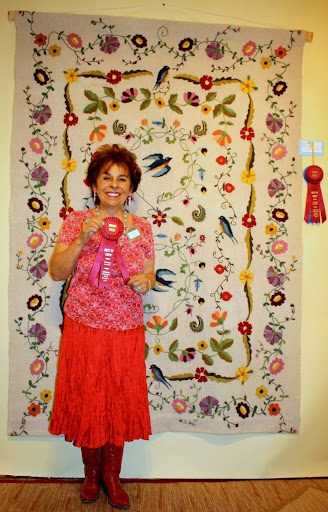
As a follow up to my last post on colcha embroidery, Julia Gomez was kind enough to send in a photo of her incredible masterpiece, El Jardín de las Golondrinas (The Garden of Swallows). It won Best of Show at the Santa Fe Spanish Market in 2010 and is currently on display in the Albuquerque Museum through March. Sure wish I could see it in person – isn’t it great? She also has kits for sale, but you’ll have to contact her directly for details.
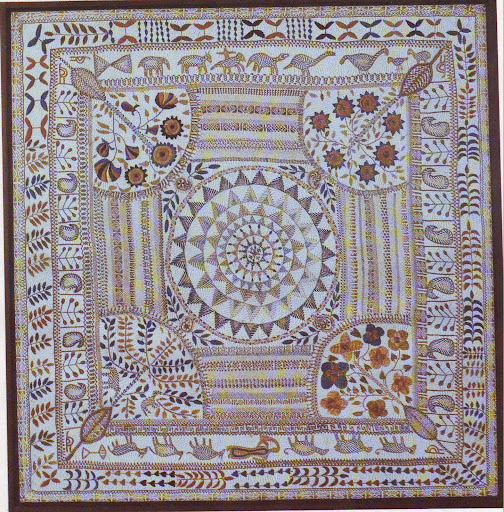
One of my commenters, Sharon, requested more information on Kantha embroidery. I think she will be very happy with this post! I found my information through Deepa’s blog, which has a nice section on Indian embroidery (other embroidery too, but I was looking for Kantha embroidery specifically). The main stitch in Kantha embroidery is running stitch. It sounds very simple but the designs are amazingly complex. The picture to the left is from Wikipedia’s article on Kantha.
Introduction (contains a brief text overview followed by many examples of Kantha embroidery). Here are some screenshots:
This is followed by a number of stitch demonstration videos, which are very clear videos of someone working the given stitch from the beginning to cutting the thread off. They are set to background music, and there is no speaking.
Demonstration of feather and herringbone stitch: The video states that feather stitch is mostly used as a decorative stitch in border designs. Herringbone stitch is sometimes used as filling for petals and leaves instead of running stitch.
Finally, here are a few of Deepa’s other Indian embroidery tutorials (each photo is linked to the tutorial):
 I thought I’d mention some kits that caught my eye the other day. These are combination cross-stitch center/blackwork frame designs of wildlife from Rose Swalwell of Derwentwater Designs (couldn’t find the designer homepage, so I picked a shop). In the Bird Brocade design I’ve been working, the central bird stands out in wool against a floss background. These designs draw attention to the central figure by switching embroidery techniques. They’re a little too much cross stitch for me, but I really like the idea of using a change in style to create contrast in the design.


 Estense embroidery is a lovely embroidery inspired by designs on Graffito ceramics in Ferraro, Italy. There’s a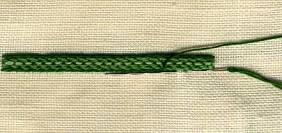

 Tuesday there were lots of people
  both pieces were incredibly beautiful and perfect silk work. Then she showed us a commissioned project worked in black lacquer thread. She is an incredibly friendly, kind woman and was delighted to see people taking an interest in embroidery. In fact, she gave my mother as a gift two traditional Japanese needles and a pincushion. Apparently, the big needle is used like a laying tool, to make sure
  your satin stitches lay smoothly. She gave us a demonstration and some tips. My mother bought the Japanese silk in the photo in this post (the shop owner says most silks in Japan are Chinese but these are genuinely Japanese). I’m afraid I have no photos from the shop, but I have a pamphlet she gave
  us, and the photos here are her work.




 embroidery for ducks