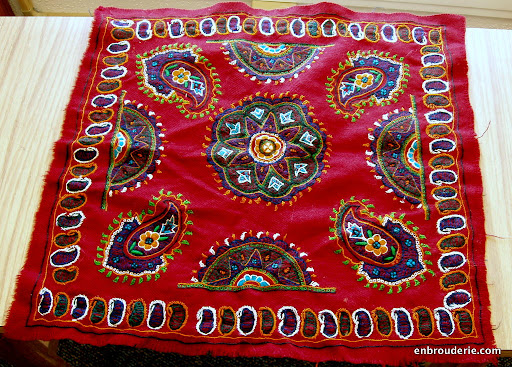
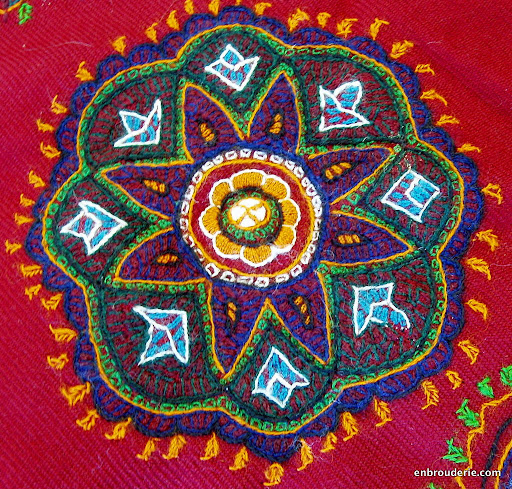
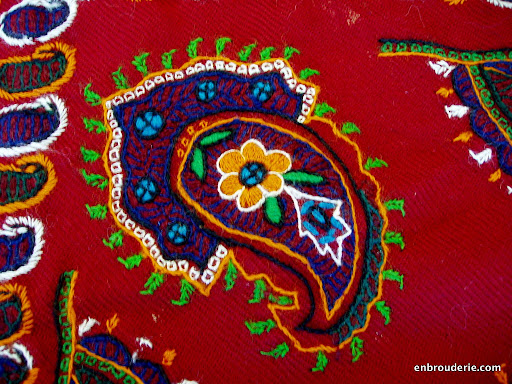
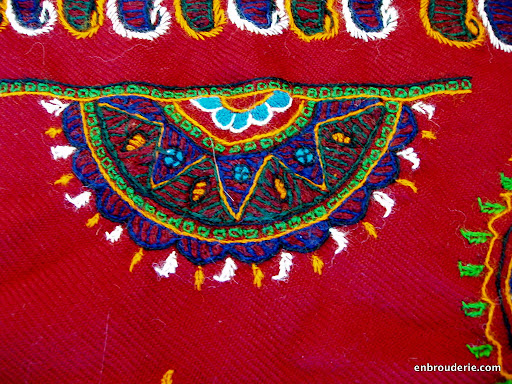
Something exciting came in the mail yesterday! My friend moved to Egypt in July, and has been having all kinds of adventures in Cairo. She knows about my blog, so she sent me a present!
The tag says it’s from a fair trade association for selling handicrafts, and this one was made by a group of North Sinai Bedouin women. The tag says “Each design and color combination holds social and/or cultural meaning” but totally fails to say what meaning that is. Just enough information to be frustratingly vague. Maybe Dr. Shirazi would know something. I will have to do some research. It does mention that the design is inspired by patterns used to decorate traditional Bedouin wedding galabeyas (a special type of traditional dress).
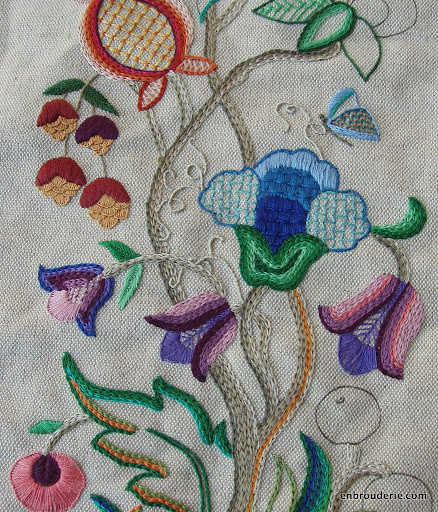
Y’all, I lost count of the number of posts I’ve done on this project. Behold the update photo! I finished the last berry on the left side with purple at the top for variety. I might add some horizontal laid stitches to the light blue satin stitch on the flower just for continuity with the rest of the solid coloring.
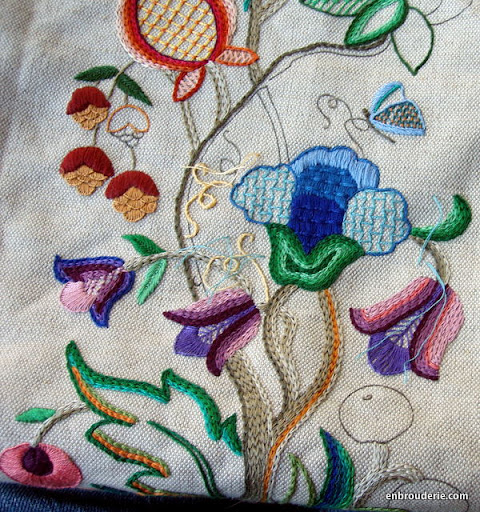
Below is the last update photo I took of this region. You’ll notice I changed the vine tendrils from pale yellow to gray. I decided the tendrils would be more effective as interesting details on the background vine. There’s plenty of color in this piece already, and I want to keep the focus on the fruits and flowers. I filled in the main vine, too.
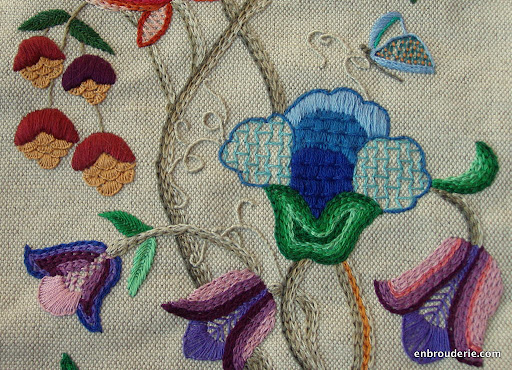
I’m sure y’all would like to see it up close too, so here’s a bonus photo. Sadly, the purple buttonhole on the rightmost bell is very loose and needs to be redone.
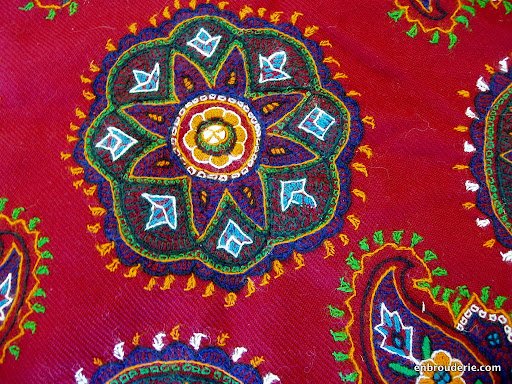
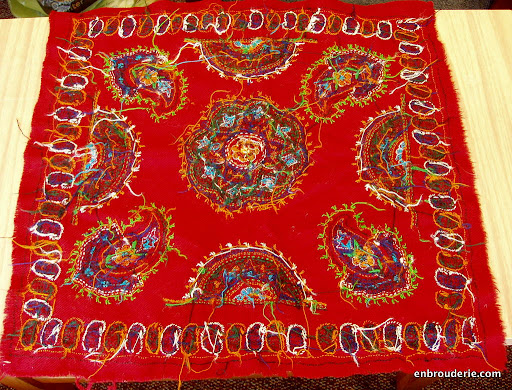
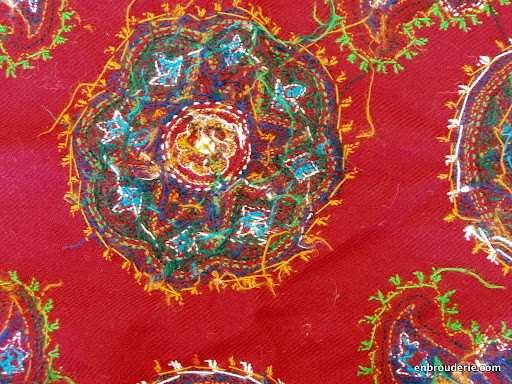
Today I present another example of pateh embroidery from Dr. Shirazi’s collection. I believe pateh is from the Kerman province of Iran.
Here are some details of the stitching. I love the way the background fabric is allowed to show through.
Finally, check out the back of the work.
This is one of a special series of posts based on the embroidery collection of Dr. Faegheh Shirazi, from The University of Texas at Austin. Her research is on “textiles, dress, gender identity discourse, and material culture in the Middle East; the meanings of veiling; rituals and rites of passage as they relate to material culture.” Over the years she has collected a number of examples of embroidery from around the world, and has very kindly allowed me to photograph them for my blog.
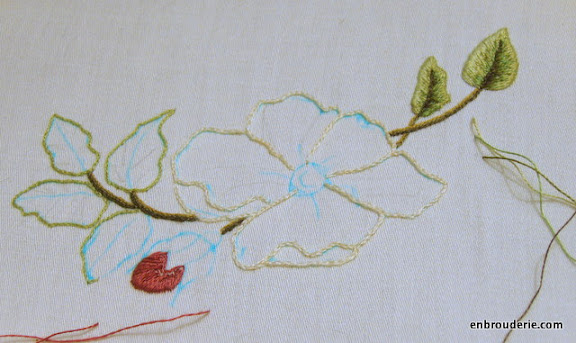
You know, I don’t think I really understood before just how many petals a chrysanthemum has! I’m still working on outlining the petals. It’s definitely coming along, though. The end is nigh. (That really doesn’t sound as positive as I mean it).
The lighting is bad this morning, but I need to get to work, so I’m posting them anyway. I’m sure y’all will survive.
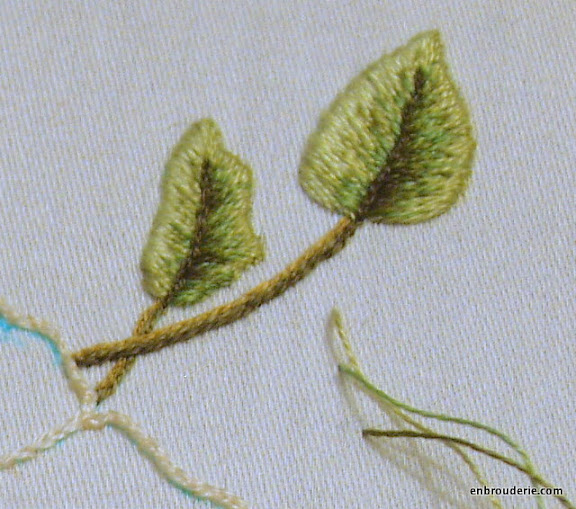
Y’all, I got the new beginning needle-painting book by Trish Burr! I started my first project this weekend – it’s not the simplest or smallest project in the book by a long shot, but I liked it. I want to work my way up to realistic birds. I’ve finished two leaves and the stems so far. I started on the bud, but I had poor lighting and couldn’t see the differences in the pink shades so I’ll probably have to restart it.
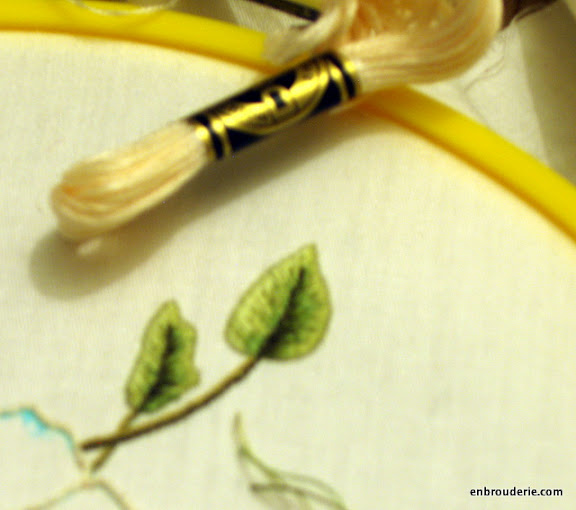
The hardest part was fitting all those colors into those dadgum leaves! I had to fit four colors into half a leaf. You can’t make the long stitches half an inch like I usually do if the leaf ain’t even half an inch wide. Here they are next to a skein of floss for some perspective on size:
Anyway, let me know if you have suggestions for improvement – I have four more leaves left! Here is a better photo of them.
One thing I really like is that Trish Burr chose different kinds of greens. They range from light to dark, but they also change colors – some are more blue, some are more olive, some are more yellow. You’ll also notice the petal and leaf edges are more wavy than stylized shapes.
Anyone else working projects from the book? I’d love to hear from you!
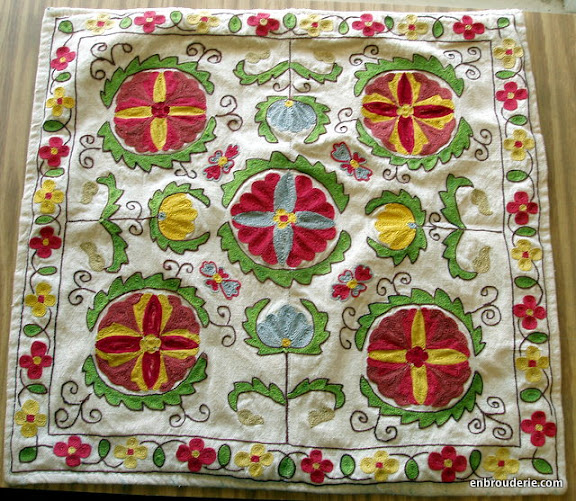
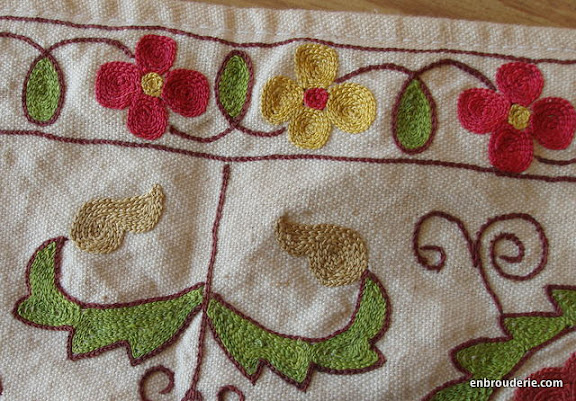
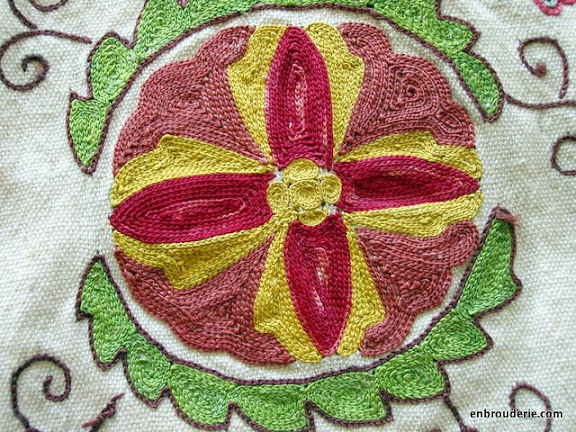
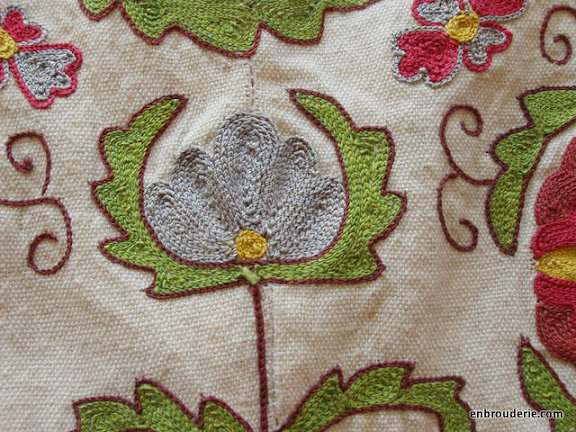
Y’all, here is a suzani from Tajikistan worked entirely in chain stitch. I believe they used a tambour hook, which I introduced yesterday through French and Indian embroidery. It’s a worldwide technique! Thanks again to Dr. Shirazi for so generously sharing her embroidery collection.
Next I’ll show a few detailed photos of the motifs, so y’all can appreciate what a tambour hook can do. I’d hate to work this without one! I think incorporating tambour into my needlework repertoire alongside other needle-based techniques could be really interesting. I also now think the Hmong embroidery with spiral motifs could have been worked with a tambour hook.
This is one of a special series of posts based on the embroidery collection of Dr. Faegheh Shirazi, from The University of Texas at Austin. Her research is on “textiles, dress, gender identity discourse, and material culture in the Middle East; the meanings of veiling; rituals and rites of passage as they relate to material culture.” Over the years she has collected a number of examples of embroidery from around the world, and has very kindly allowed me to photograph them for my blog.
A lot of blogs have linked to the NPR story on the French embroidery studio Maison Lesage, plus Dr. Shirazi sent me the link. It’s about tambour embroidery, which is the type of embroidery used in French fashion embroidery. This is worked with a tambour hook instead of a needle, and incorporates beading and sequins. Maison Lesage is now owned by Chanel, but it’s actually 130 years old. Here’s a video about it:
Indian embroiderers also use this tool. Here is a video of silver Zari work with the tambour hook. That’s some fast stitching!
I decided to try this myself! The traditional tambour hook is a crochet hook with a pointy tip to pierce the fabric. I bought a slightly altered one (since it was easily available), called the Clover Embroidery Tool. It has an extra spring latch on it so the hook doesn’t catch on the fabric.
I imagine it takes a little extra effort to learn the one without a latch, but it’s probably worth it if you have very fine, very closely spaced work where the latch might get in the way. I’m just experimenting now though, so I don’t mind. There is an instructional video from the Clover company:
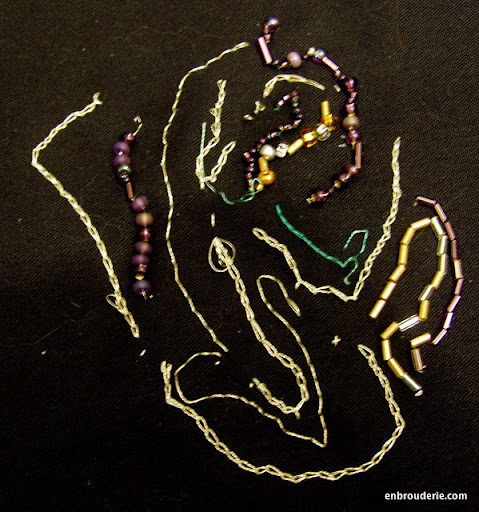
For my experiment, I used a black cloth napkin from thrift shop (36 cents!), plus a couple of packs of beads (purple and yellow). I had no design, just stitched randomly. Basically, the hook produces chain stitching on one side of the fabric (see the line at the left of the photo below), and something that looks like backstitch on the other side (see third line from left in the photo). If you add beads to the linear side, you get the line of beads (second from left).
I’m still very clumsy but improving rapidly. The first thread I tried (the green) kept snapping and dumping beads everywhere. The silver worked much better. Whenever the thread is too loose, it slips off the hook and the thing unravels, so tension is important. My stitching is not very even yet, and I don’t turn corners well. However, my beading and chain stitch are definitely improving and starting to look very cool! I can already tell that with a little practice I could cover a lot of ground very fast. I believe my past experience with crochet is also helping.
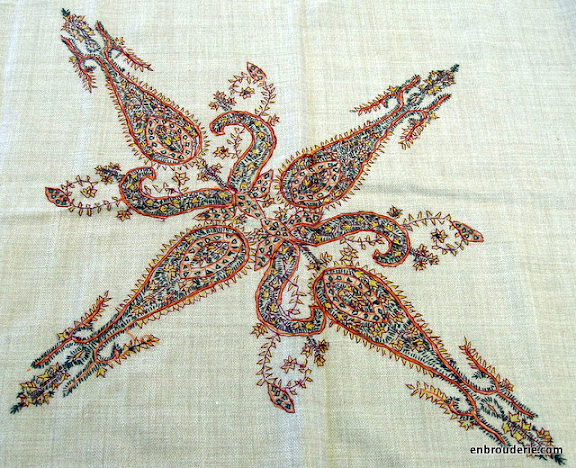
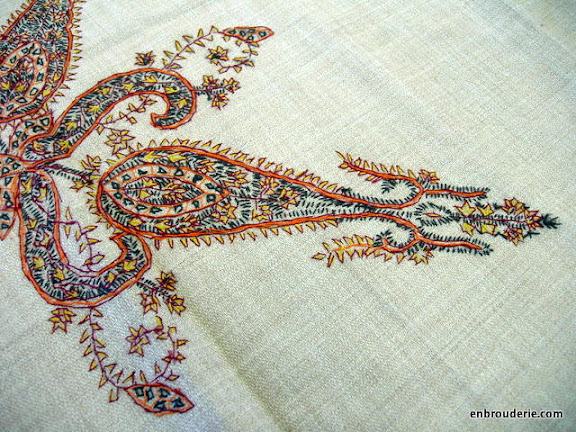
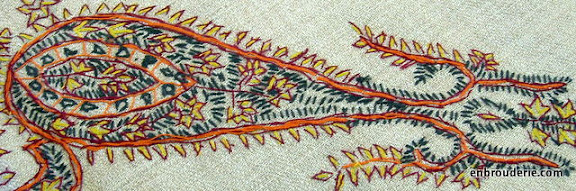
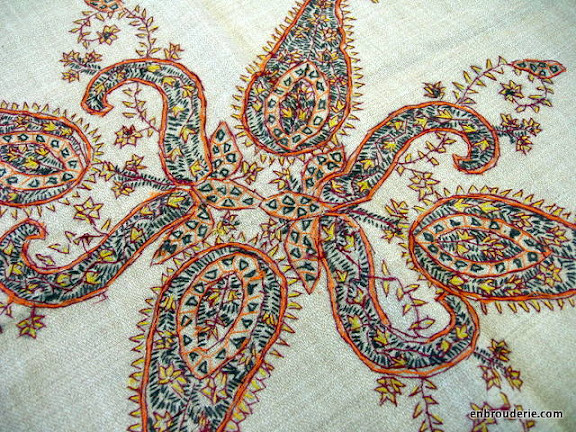
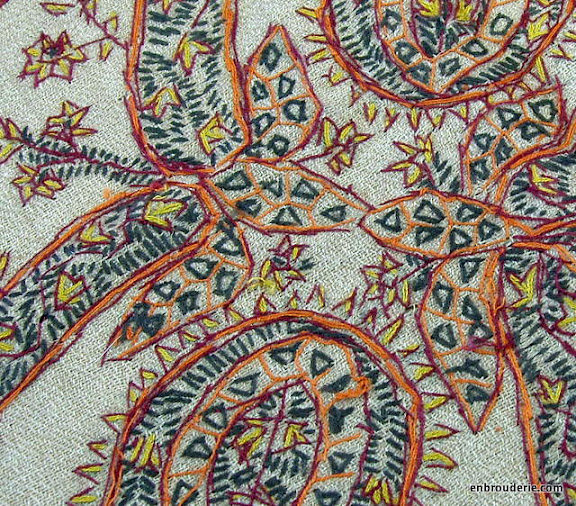
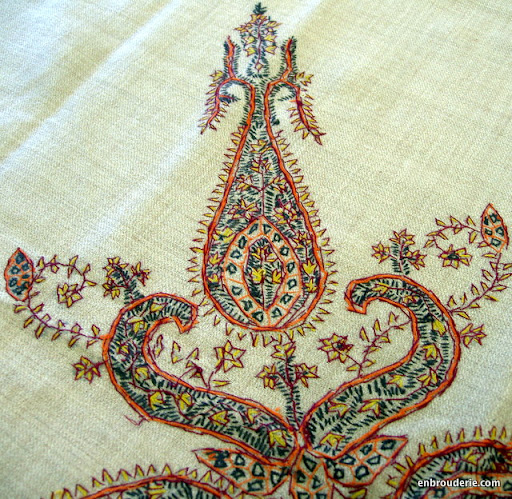
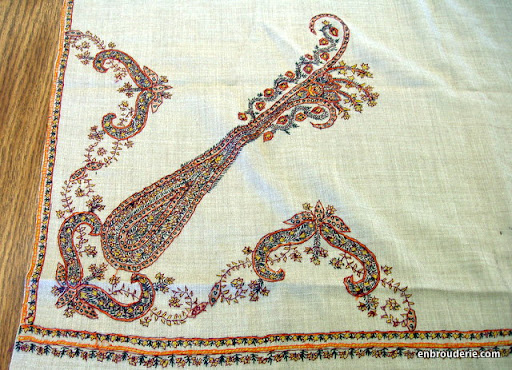
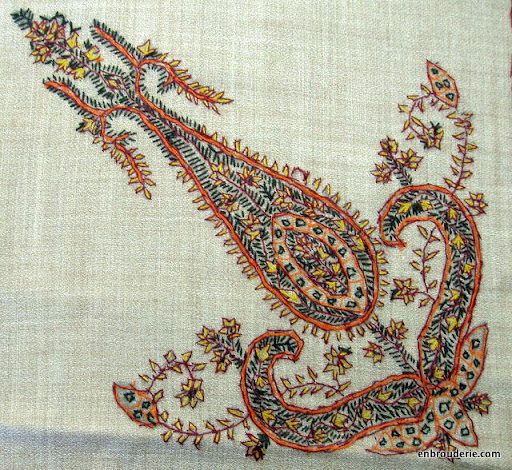
As promised, here is the central motif on the embroidered shawl from Kashmir (first mentioned in the post Embroidery of Kashmir I). This is a woman’s shawl – you can tell the difference because men’s shawls have no central motif and less embroidery.
The quality and price of the shawls is determined by the complexity and size of the embroidered borders and motifs. Commercial embroidery to sell is generally done by men. Women do more embroidery for the home.
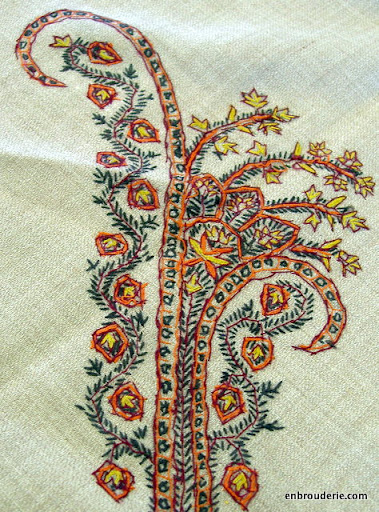
I’ll just finish with a series of detailed photos so you can see the stitching.
This is one of a special series of posts based on the embroidery collection of Dr. Faegheh Shirazi, from The University of Texas at Austin. Her research is on “textiles, dress, gender identity discourse, and material culture in the Middle East; the meanings of veiling; rituals and rites of passage as they relate to material culture.” Over the years she has collected a number of examples of embroidery from around the world, and has very kindly allowed me to photograph them for my blog.
This is a review of The Art of the Needle: Designing in Fabric and Thread by Jan Beaney. Pantheon Books, New York, 1988. ISBN 0-394-57303-X.
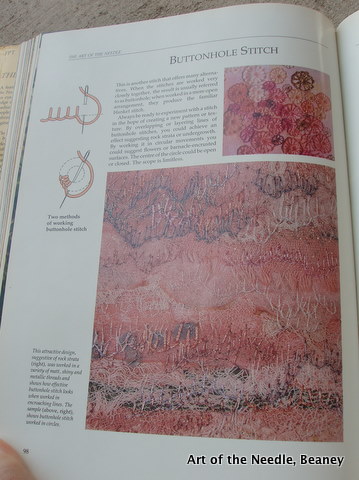
The book is an introduction to design for embroidery. It’s written in a friendly and enjoyable style, easy to understand, but without talking down to the reader or oversimplifying concepts. It covers some of the same topics as Sharon B’s wonderful Sumptuous Surfaces class (yes, I took it!). I also want to note that this is a beautiful book. It’s a treat even to flip through looking at the photos – just a really gorgeous book visually.
The first chapter is Design Starting Points – where to get ideas, how to change ideas into designs, how to incorporate color and texture. It doesn’t simply give a list of concepts – it talks you through how to actually implement them. For instance, in the section on drawing and finding ideas from what’s around you, there’s a section “Getting to Know a Plant” with over a dozen suggestions such as “Draw the outline of a single leaf. Take particular note of the edge. Is it crinkly, indented, crisp, or hairy? Has it been partially eaten away?”
The chapter also addresses how to take a sketch and use it to create a full blown design, such as the oranges example shown at right. There are sections on color and texture, and examples of finding color and texture inspiration in everything – even a corrugated iron fence (see photo with embroidery insets below).
The chapter on fabric paints with embroidery is really interesting. The book finishes with a wonderful set of examples (with discussion!) of embroidery design inspired by a variety of techniques.
I strongly recommend this book. The author did an amazing job of explaining and demonstrating color and design for embroiderers. Plus, y’all have just got to look at the photos of her embroidery and I can’t post them here!
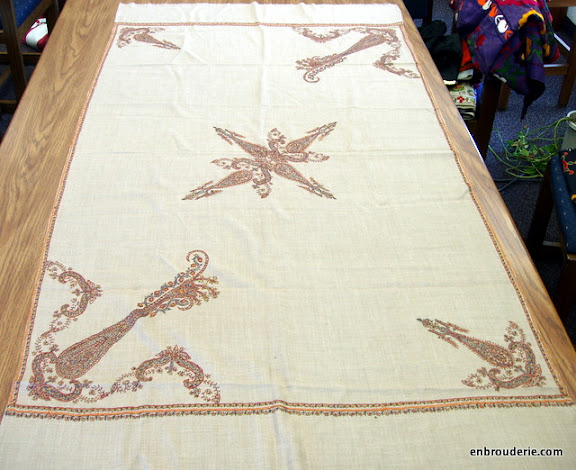
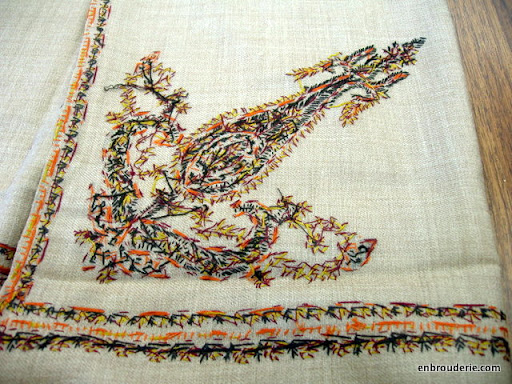
Today I introduce another style of Indian embroidery, from Kashmir! This piece is also from Dr. Shirazi’s personal collection.
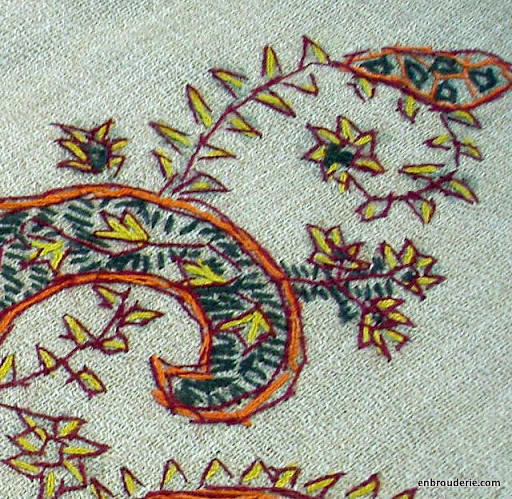
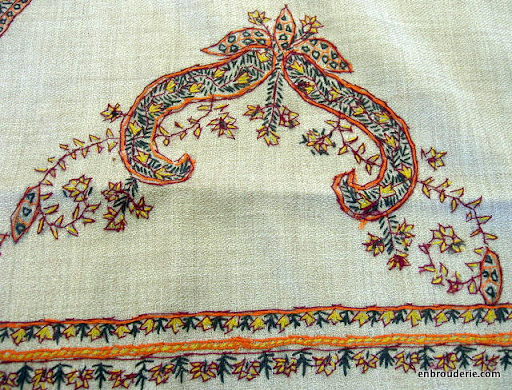
Here is a closer view of one of the corners. The designs are amazingly intricate but use very simple stitches.
An even closer view:
Here is the smaller corner design, plus a view from the back:
I will continue with photos of the central motif another day! See you later 😉
This is one of a special series of posts based on the embroidery collection of Dr. Faegheh Shirazi, from The University of Texas at Austin. Her research is on “textiles, dress, gender identity discourse, and material culture in the Middle East; the meanings of veiling; rituals and rites of passage as they relate to material culture.” Over the years she has collected a number of examples of embroidery from around the world, and has very kindly allowed me to photograph them for my blog.



 This is a review of The Art of the Needle: Designing in Fabric and Thread by Jan Beaney. Pantheon Books, New York, 1988. ISBN 0-394-57303-X.
 The first chapter is Design Starting Points – where to get ideas, how to change ideas into designs, how to incorporate color and texture. It doesn’t simply give a list of concepts – it talks you through how to actually implement them. For instance, in the section on drawing and finding ideas from what’s around you, there’s a section “Getting to Know a Plant” with over a dozen suggestions such as “Draw the outline of a single leaf. Take particular note of the edge. Is it crinkly, indented, crisp, or hairy? Has it been partially eaten away?”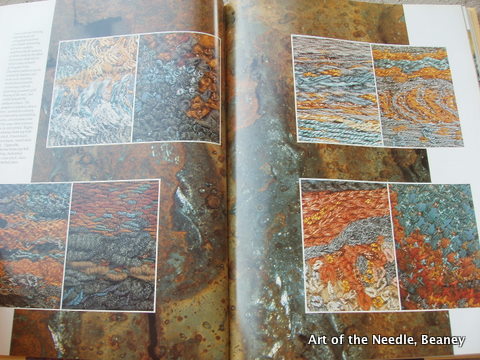
 embroidery for ducks