I settled on Japanese darning stitch for the light blue airy petals of these flowers. I’d never tried this stitch before, but I love the effect. It’s easy and quick. I have no idea if it’s actually Japanese or not though!
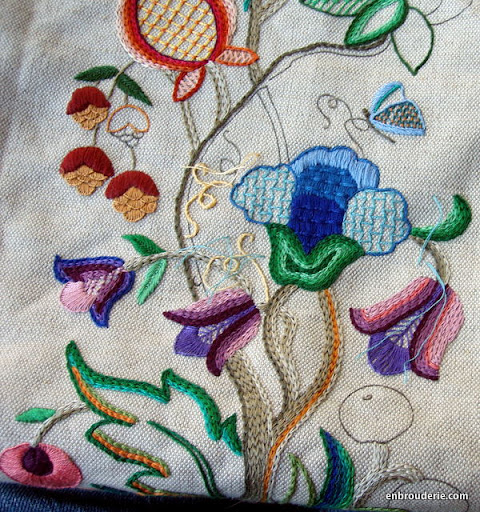

I settled on Japanese darning stitch for the light blue airy petals of these flowers. I’d never tried this stitch before, but I love the effect. It’s easy and quick. I have no idea if it’s actually Japanese or not though!
Erica asked if I was sure the piece shown in Hardanger Inspiration was hardanger and not Punto Antico. I thought I’d reply in a post since my answer was getting a little long and perhaps others would be interested too.
Yes, it’s hardanger – see all the kloster blocks? So far as I can tell from surfing around, many hardanger patterns stick to using simpler fillings, but that doesn’t mean the fancy stuff isn’t out there! I think people are sometimes a little intimidated by the more complex stitches so they are used less, which makes them less visible, and then people are less likely to hear about them.
So, what is Punto Antico? This essay on Punto Antico from the Embroidery School of Borgo San Lorenzo presents some photos and stitch instructions. Jeanine at Italian Needlework also has a post about Punto Antico with photos, and wrote several articles on the subject for Interweave. This (beautifully illustrated) article on Punto Antico says the difference between the styles is that, “Unlike those of Hardanger, the openwork shapes of Punto Antico are outlined in either double running stitch or backstitch, and then the center of each shape is cut diagonally to form an X from corner to corner. The resulting flaps are folded to the back of the fabric and secured with Punto Cordoncino (cord or overcast stitch) worked over the top and enclosing the double running stitch outlining the open area; the excess fabric is then cut away.” Her other article provides free instructions for a Punto Antico Biscornu.
I ran across a blog, Coffeebean’s Dailies, with some amazingly beautiful hardanger photos and I wanted to share with y’all (yes, I asked for permission). Here is the photo of the entire piece:
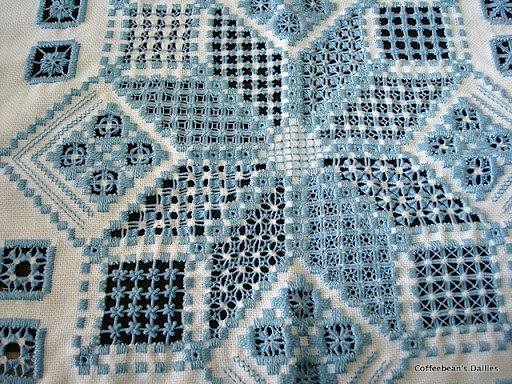
Isn’t it incredible? I think I should learn hardanger. Alia posted a number of photos of beautiful details of the hardanger in a post. To inspire you to go take a look, here are a few of them (to see more, go look at her blog! definitely worth it! look how many more sections there are!):

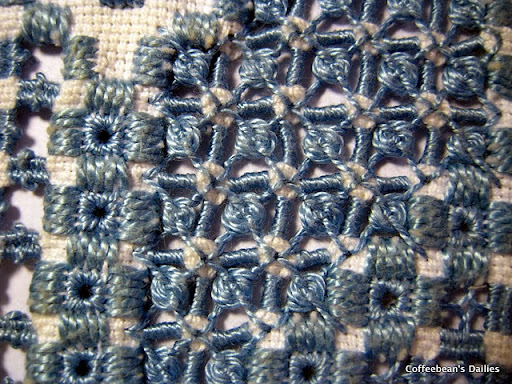
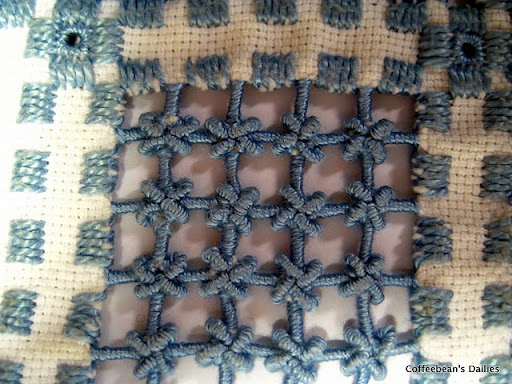
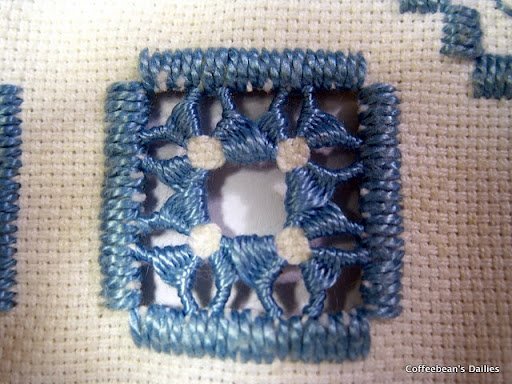
You should also check out her new in-progress hardanger project, which is very beautiful too. If you want links to free tutorials and hardanger design companies now that you’ve been inspired, check out my archive of hardanger posts.
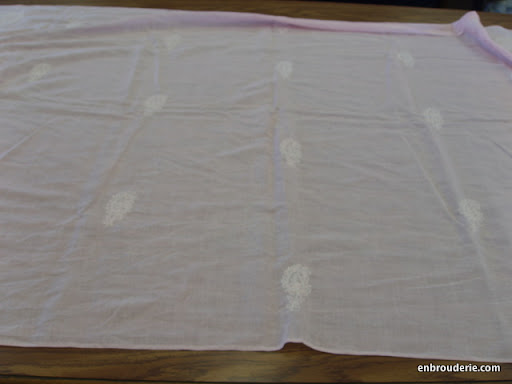
Chikan work, or chikankari, is an Indian form of shadow work. This example from Dr. Shirazi’s collection is worked in white thread on pale pink fabric.
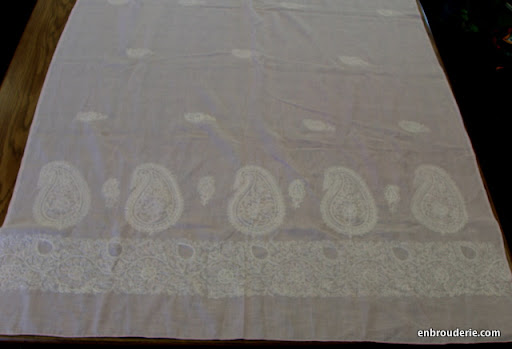
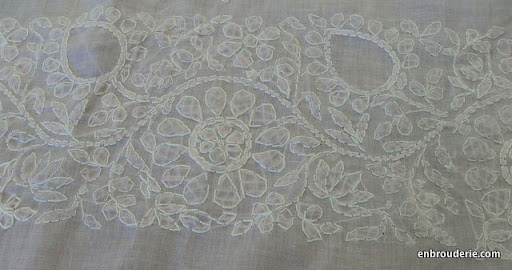
It’s incredibly detailed for such a large piece – it covers the table in the photo, and that is a table for eight people. The fancy border is worked at each end. Here is a closer view:
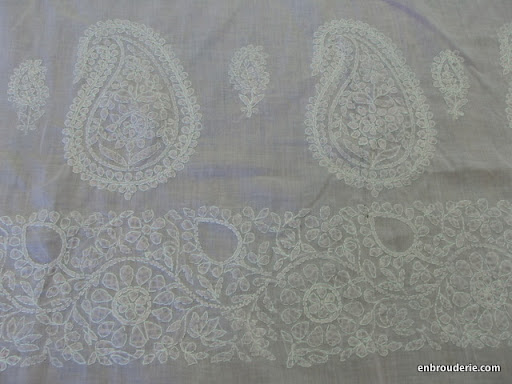
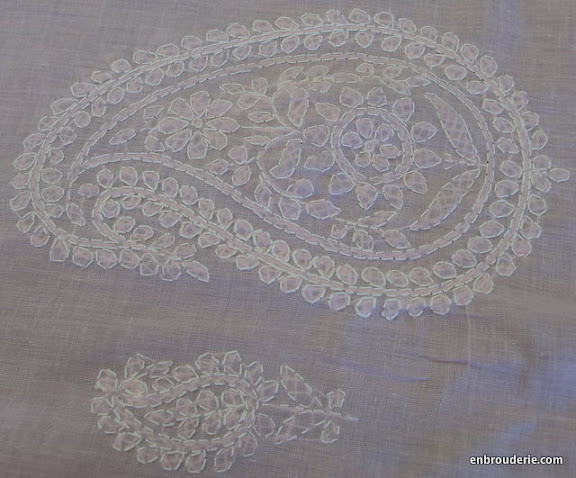
It’s really beautiful. If you take a really, really close look, you see that this is actually shadow-work.
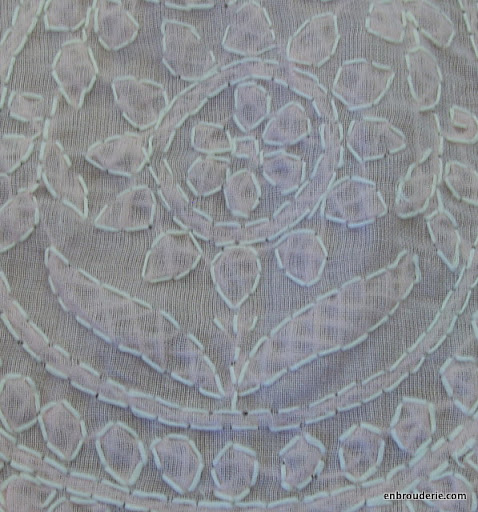
The entire piece is worked in herringbone from the back! The fabric is thin enough that you can see the herringbone stitch through the fabric, and that creates the color in the design! The herringbone naturally provides an outline to all the shapes on the opposite side. Here is the back of the embroidery:
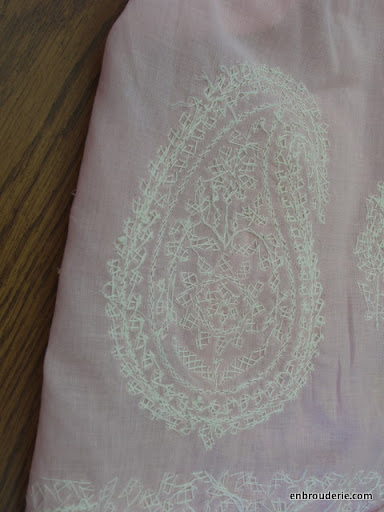
The pink color is more obvious once you’ve folded the fabric over a few times, and it stops being so see-through. Here is another photo of the back:
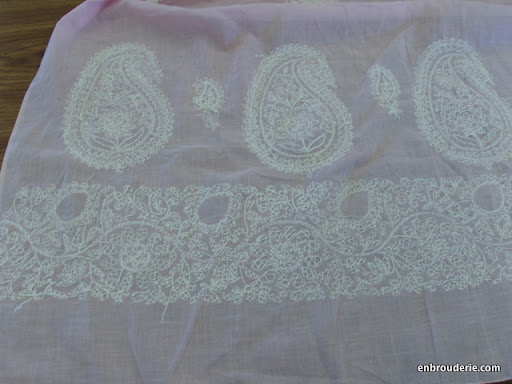
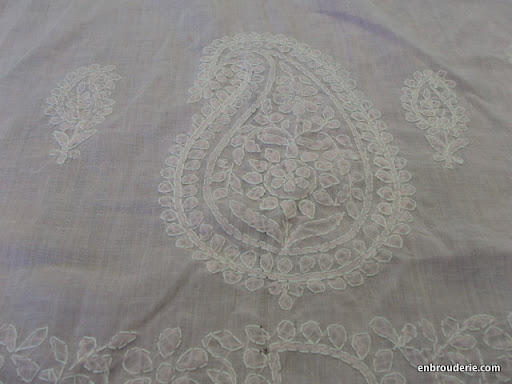
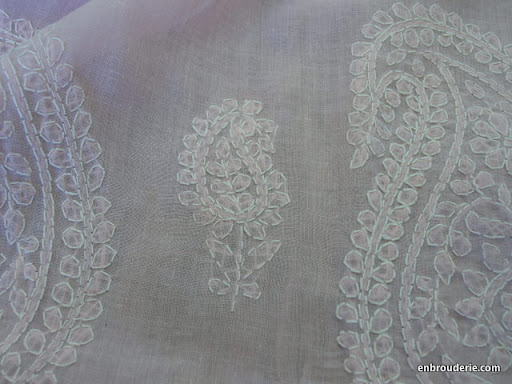
Now I know y’all aren’t tired of looking at it, so I’m going to end with a whole bunch of photos of the work.
This is one of a special series of posts based on the embroidery collection of Dr. Faegheh Shirazi, from The University of Texas at Austin. Her research is on “textiles, dress, gender identity discourse, and material culture in the Middle East; the meanings of veiling; rituals and rites of passage as they relate to material culture.” Over the years she has collected a number of examples of embroidery from around the world, and has very kindly allowed me to photograph them for my blog.
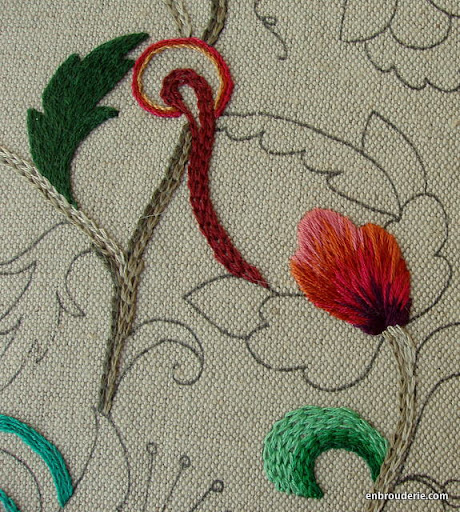
This post provides a rather long answer to my lovely reader Wendy’s question from the last post. Here is the photo of the petal from a distance.
Here is the petal next to a ruler.
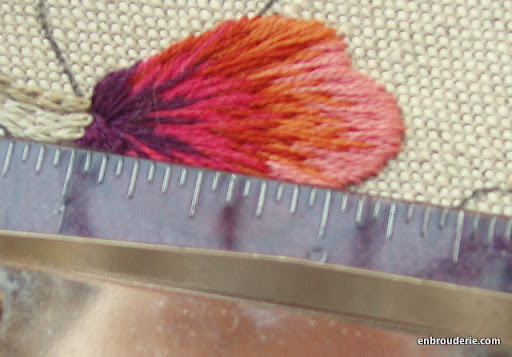
The ruler is in inches, and 1 inch = 2.54 cm. The entire petal is 1.25 inches long (3.175 cm), the petal is worked in 5 colors, and the longest stitches are 0.5 inches long (1.27 cm).
If you want long-and-short stitch to blend like this example, you must do very long stitches, and they need to be uneven. The human brain is extremely good at noticing patterns, so if you make all the long stitches the same length or all the short stitches the same length, people will immediately notice. So none of my stitches are exactly the same length. And if you always do long-short-long-short that may also stand out – so you should occasionally do short-short-long or some other combination to mix it up. You will even see some spots where a long stitch will reach all the way through a row of the middle color to touch the row of color on the other side.
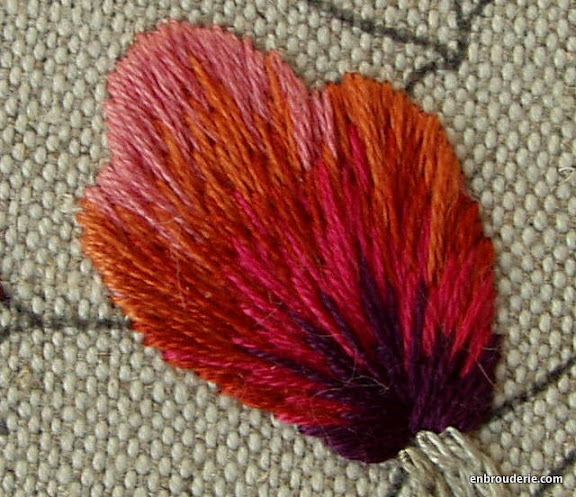
I do most of the alternate long and short stitches in the first row (at the outer edge of the petal). The following rows are mostly uneven because they follow the line of the first row, not because every row has long and short stitches. But the stitches are still not the same length – I kept it random. The very last row (the dark purple) fills in the remaining space, so it has some long and short stitches too.
This is just how to do a petal like mine. There are situations where you might want to ignore all these suggestions! Two examples:
To go read YET MORE about this stitch, you can either take a look at The Unbroken Thread’s post on her trials when learning long-and-short stitch, or for a really thorough approach, Mary Corbet’s sampler lessons for long and short stitch. If you just want eye-candy, see Trish Burr’s work.
There’s only a little bit of progress to report on the Plas Teg bellpull from the Mary Jane Collection (see project page for previous posts).
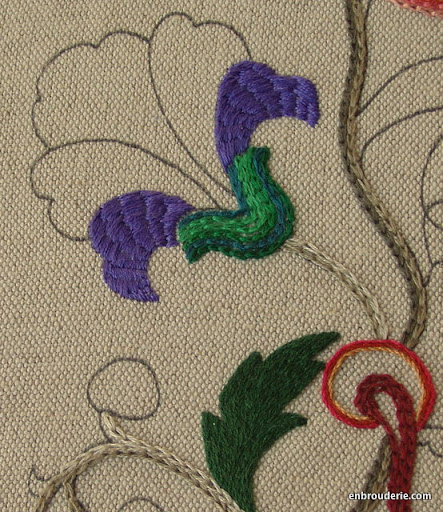
The purple is double running stitch – I was inspired by my Turkish embroidery book to try it as a solid filling (called sira ishi in Turkish). It’s really pretty and fills large curved shapes well (the original instructions suggested long and short stitch). Speaking of long-and-short stitch, I started work on this flower:
The other two petals are supposed to be worked in chain stitch, but I love this petal so much I think I will do them all in long-and-short stitch. The two pointy petals/leaves are supposed to be purple, but I’m changing them to green.
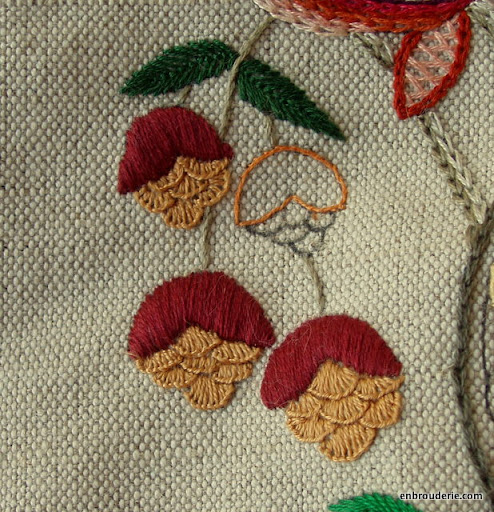
Lastly, I worked two more of the berry tops in padded satin stitch.
This weekend I thought I’d try decorating myself with embroidery. Here is my kantha embroidery hair barrette: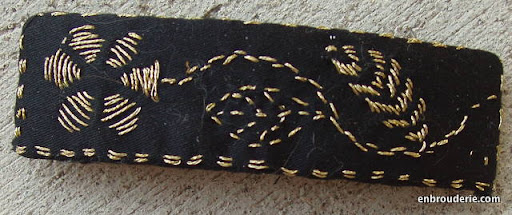
It’s metallic gold thread on black cotton sateen so it’s actually fairly shiny, though that’s hard to photograph.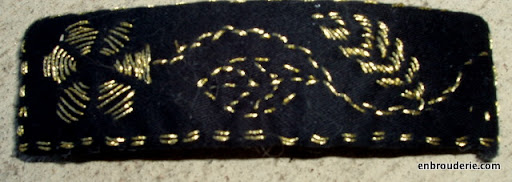
Even harder is photographing the back of my head (I didn’t have a friend nearby when writing this post).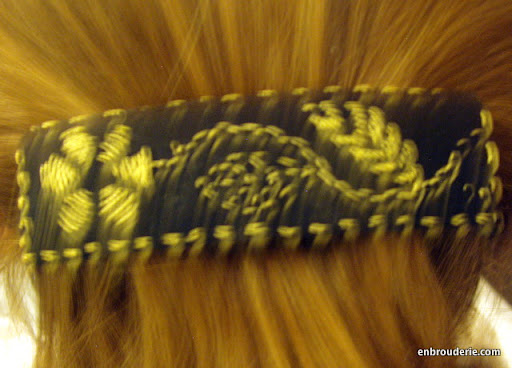
To make it, I started with a plain hair barrette from Joann’s.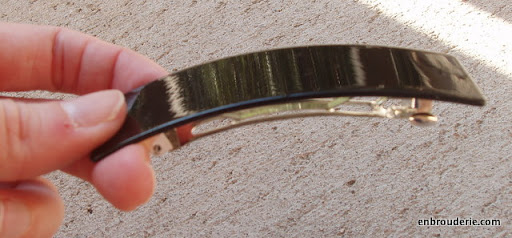
I traced the shape onto my fabric, and worked a flower in kantha embroidery (a traditional Indian embroidery based around running stitch).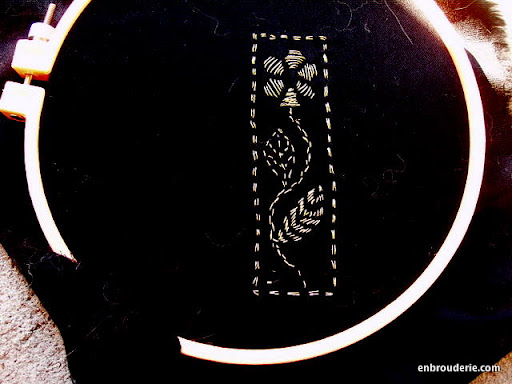
It really shines in the sun – very pretty.
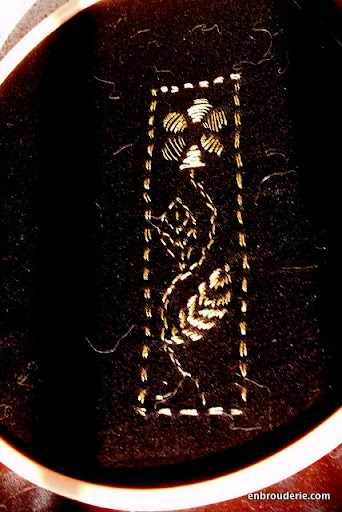
I cut the shape out with a little extra fabric around the edges, and sewed it onto the barrette over a little bit of batting for padding. I did a terrible job sewing it – it’s a mess on the back – but it doesn’t show and next time I will do better. Anybody got suggestions for the best way to attach it?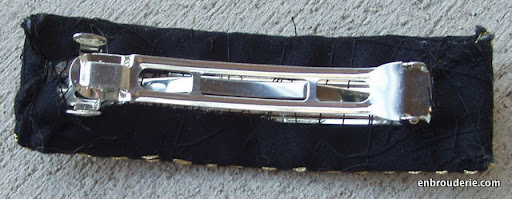
I think it came out quite lovely, and I hope it inspires some of y’all.
This embroidery (from Dr. Shirazi’s collection) is Iranian. Note the vibrant colors. (Update: this is called “pateh” embroidery). I believe this depicts a cypress tree, which is a very important motif in Iranian culture.
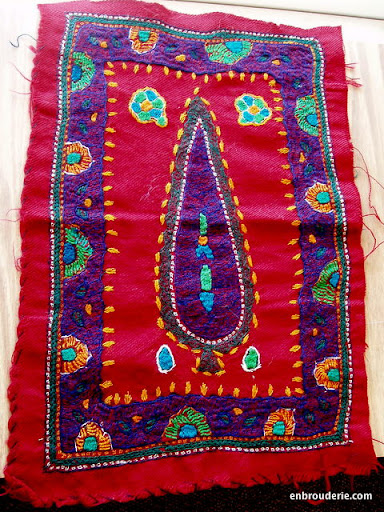
The word for cypress is “sarv” (it includes several species of tree). According to Dr. Shirazi, when a woman is compared to the beauty of sarv she is called “sarv e naaz” which roughly translates as graceful and beautiful like the sarv tree. A tall Sarv gracefully bends to the right and left when the wind goes through it and this movement is used as a metaphor of a woman walking gracefully. Internet research indicates that the cypress is also a symbol of freedom. And it’s an important feature of gardens representing paradise. Zoroaster legendarily planted two cypress trees, later destroyed.The Sarv-e Abarqu is a 4,000 year old cypress in Iran and a national monument. Anyway! It shows up a lot!
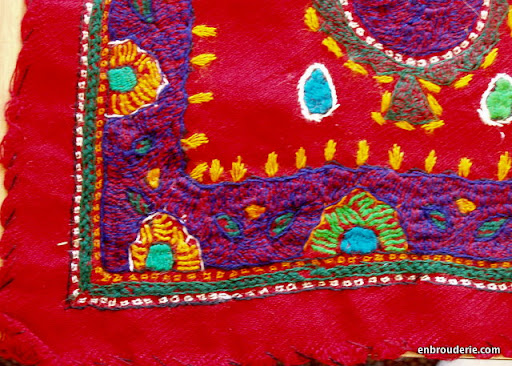
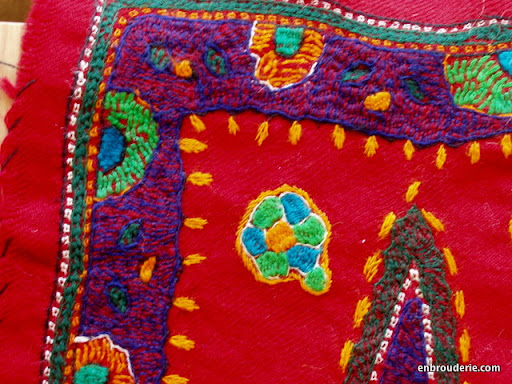
What I found most interesting about this piece is that the artist deliberately avoided fully covering the ground fabric in the embroidered areas. If you look at the close up photos below, you can see that quite a bit of the fabric shows through, creating a textured surface and a color-mixing effect. If the stitching was solid, this piece would look very, very different.
Finally, here is the back of the work:

This is one of a special series of posts based on the embroidery collection of Dr. Faegheh Shirazi, from The University of Texas at Austin. Her research is on “textiles, dress, gender identity discourse, and material culture in the Middle East; the meanings of veiling; rituals and rites of passage as they relate to material culture.” Over the years she has collected a number of examples of embroidery from around the world, and has very kindly allowed me to photograph them for my blog.
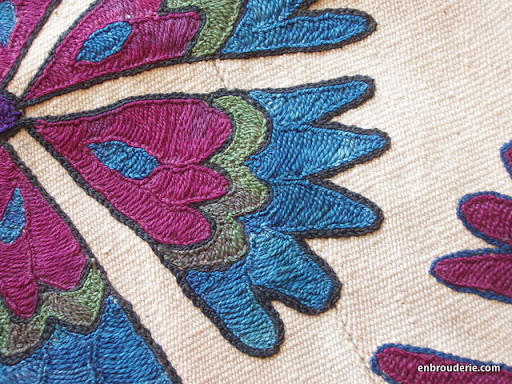
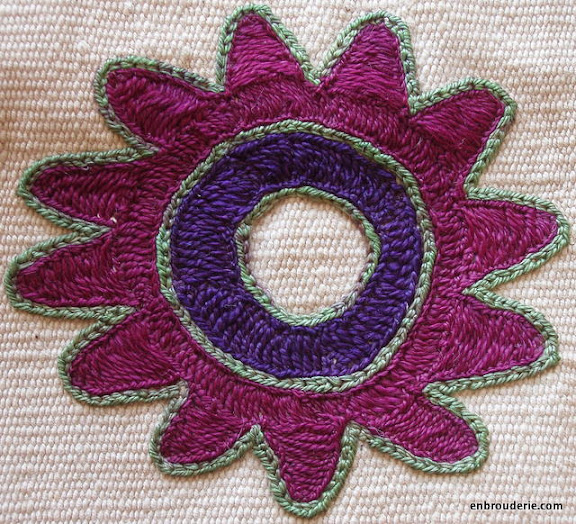
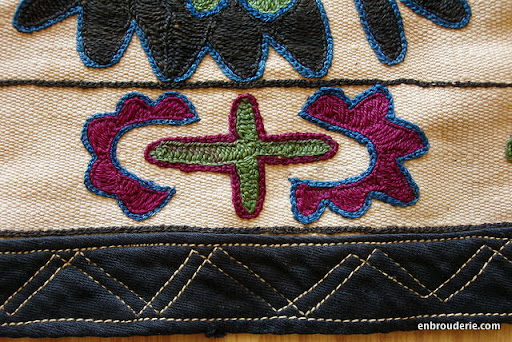
Here’s another example of a Tajikistan suzani from Dr. Shirazi’s collection. You can see similarities in some of the motifs from suzani to suzani, but they vary quite a bit in materials and colors.
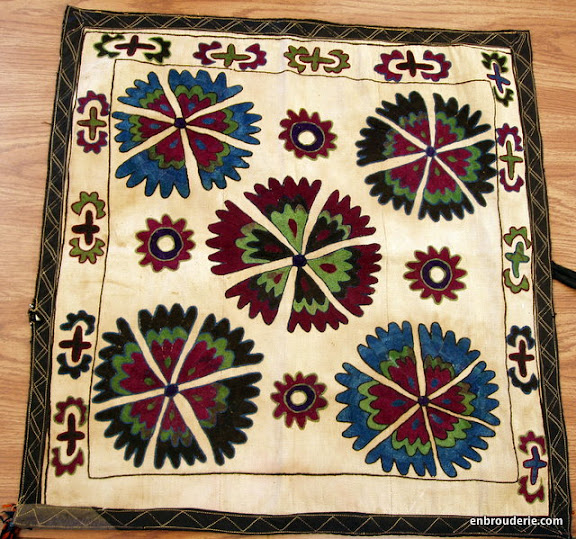
Unlike the other examples, the back of this one shows very little stitching:
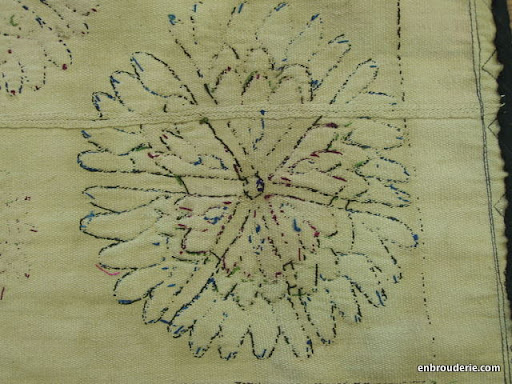
Here are some close up photos so you can compare with the others:
This is one of a special series of posts based on the embroidery collection of Dr. Faegheh Shirazi, from The University of Texas at Austin. Her research is on “textiles, dress, gender identity discourse, and material culture in the Middle East; the meanings of veiling; rituals and rites of passage as they relate to material culture.” Over the years she has collected a number of examples of embroidery from around the world, and has very kindly allowed me to photograph them for my blog.
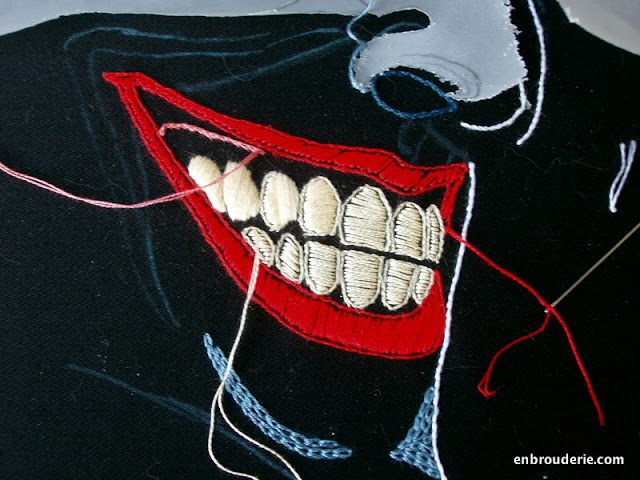
I kept working at the padding for padded satin stitch over the teeth and lips. I have one layer in two strands of floss everywhere now. The first two and a half teeth are covered in a top layer of padding, and the next tooth has two layers of padding. The rest is just a single layer.
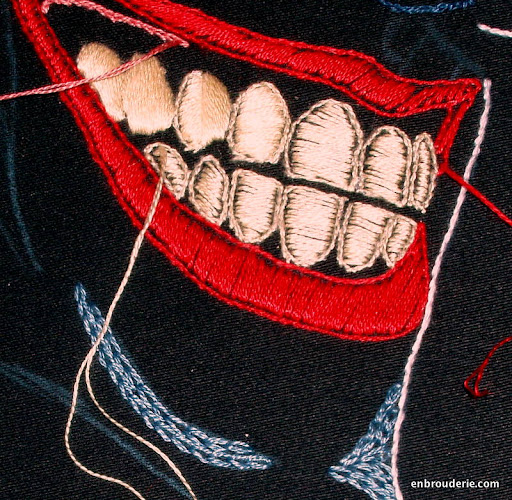
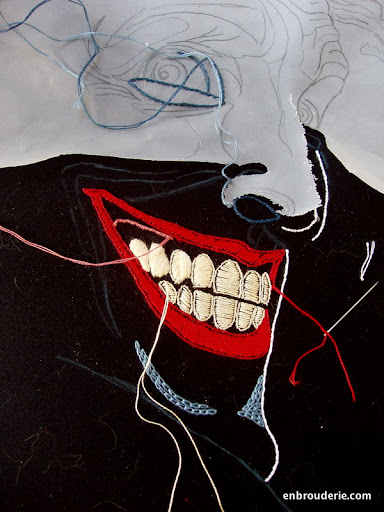
I might like this better than the original padded satin stitch plan! It looks like a quick sketch – scribbling in between the lines. Since it’s from a comic book, that’s appropriate. I could take the extra layers off those four teeth to match the rest. I might need to touch it up in a few places since I wasn’t planning for this layer to be visible.
What do y’all think? Two more layers of padding then a layer of satin stitch, or stop here?
Also, the color in the photos is still not quite right; I think the shine from the cotton sateen is throwing the camera off.
 embroidery for ducks