More Swedish Weaving

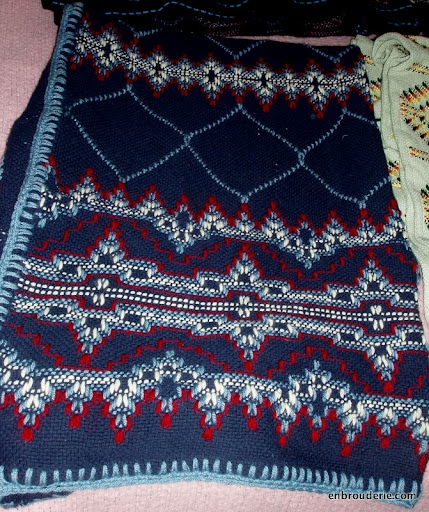
As I mentioned in my last post about swedish weaving, my grandma makes afghans with it. In fact, she made a whole lot of them (at least twenty, maybe more). I thought I’d show photos of a few of them today.

Today I’m posting closeups of three of them. Be sure to take a look at the edges – these are finished in three different ways. One has a crocheted edge, one has a running stitch hem, and the last has a fringe.

Posted in Grandma, Swedish weaving/huck embroidery | Tagged , , , , | 5 Comments

Chinese embroidered purse

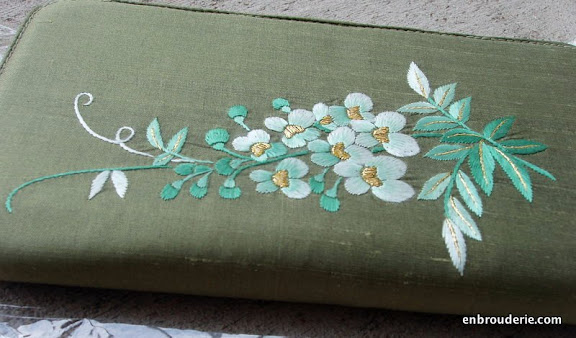
A Chinese friend of mine gave me this lovely purse from China to show y’all. Green and gold go well together.

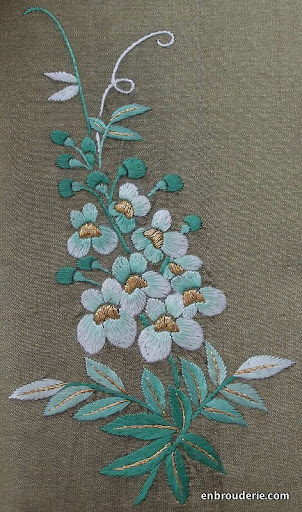
It’s so pretty! It’s mostly a monochromatic design in four shades of green. Plus a few gold accents. Here’s another view of the design:

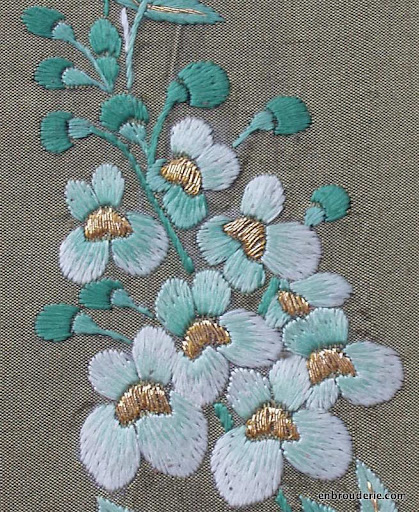
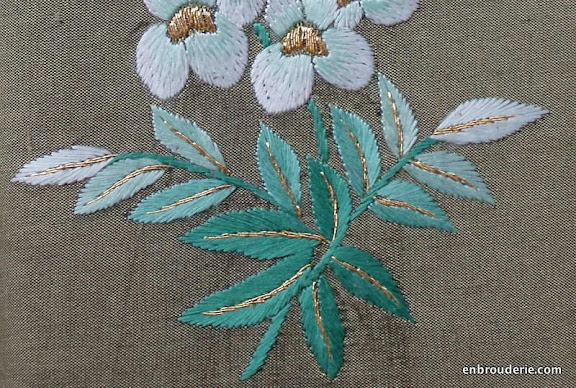
If you look at the close-up of the flowers below, you can see what a wonderful job they did shading the petals with long-and-short stitch. On some of them you can barely see the separate shades. And the gold centers help define these as individual flowers instead of just a large mass of petals.

The leaves, however, are blocks of solid color. They are shaded as blocks along the branch – darker at the center and lighter at the tips. I like the way they kept the shading scheme from the flowers but switched to block shading as a variation on the theme.

Posted in Embroidery around the world | Tagged , , , , | 3 Comments

Book Review: International Needlework Designs

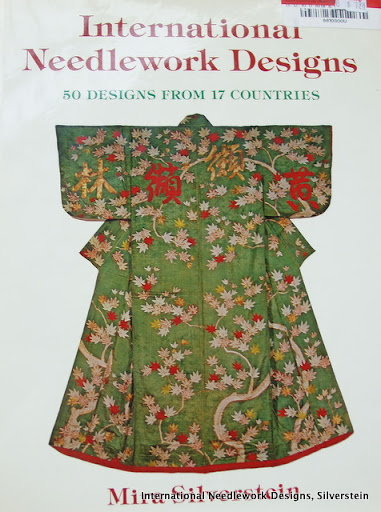
This is a review of International Needlework Designs, by Mira Silverstein. Charles Scribner’s Sons, New York, 1978.

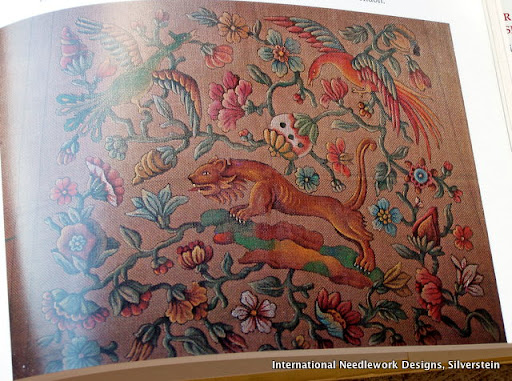
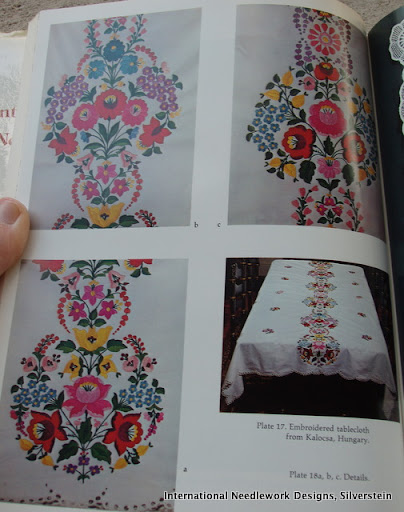
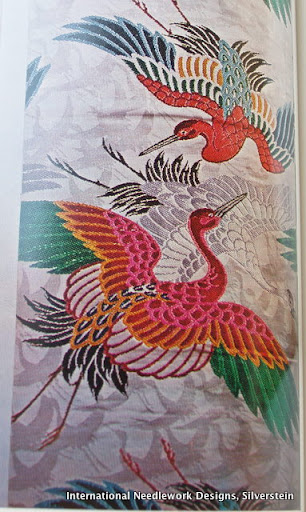
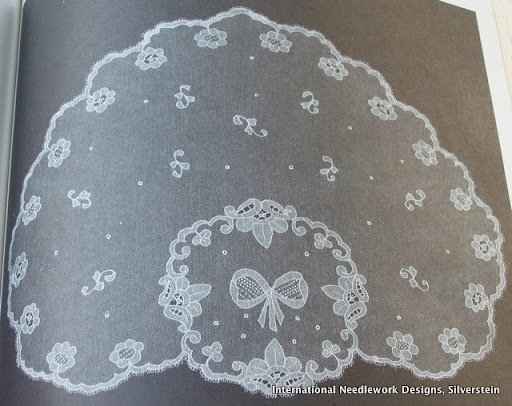
I love this book! It has an enormous variety of styles in it, and Ms. Silverstein picks out really lovely designs. I flip through this book and say to myself “I want to make that one. And that one. And that one. And …” The book talks about each country and embroidery style, with examples. It provides photos of the original piece plus a pattern outline for all 50 designs. Here are a few examples from the book:

There is a lovely and thorough section on Kalocsa embroidery. It provides the designs for all the embroidery in the photo to the left, plus a few more.

For some designs, like the Japanese cranes from a woven obi, it provides suggestions for how to adapt the design to embroidery. For others, like the Carrickmacross lace veil, it provides detailed instructions for reproducing it with the original techniques.

Other countries covered in the book include Denmark, Guatemala, and Cambodia.

Posted in Book reviews, Embroidery around the world | Tagged , , | 1 Comment

Crewel embroidery pillow

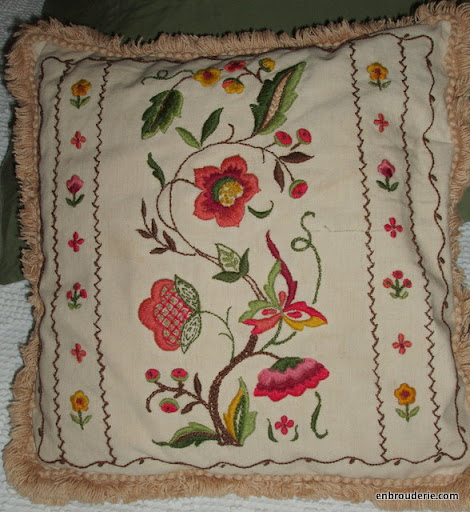
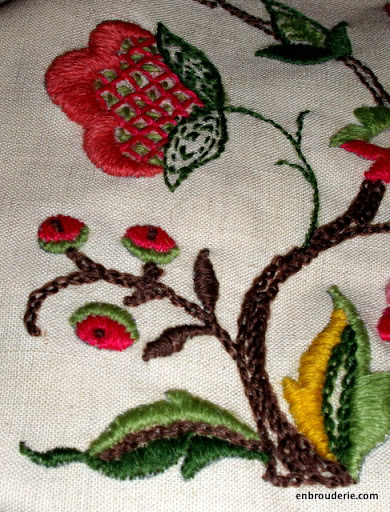
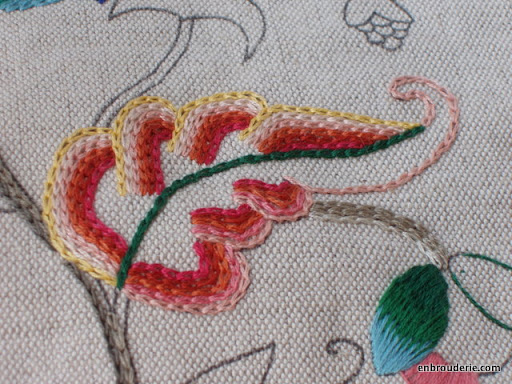
This crewel pillow was made by my great-grandmother. The dominant colors are shades of pink and green, plus brown. There are spots of yellow acting as an accent color. It’s an effective color scheme.

The satin stitching is really pretty in this area:

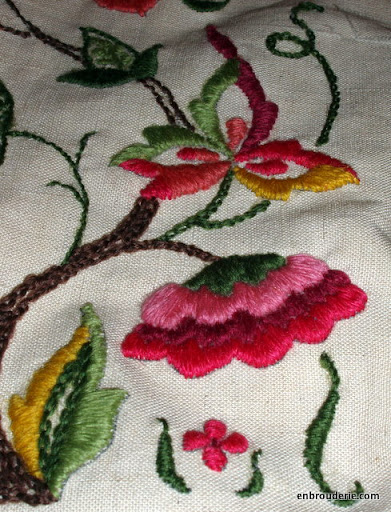
I see chain stitch, trellis stitch, french knots,  satin stitch, and running stitch in the photo  below.

I like this flower and the leaf with the chevron filling down the center.

Posted in Crewel, Grandma | Tagged , , | 14 Comments

Plas Teg Bellpull Flowers

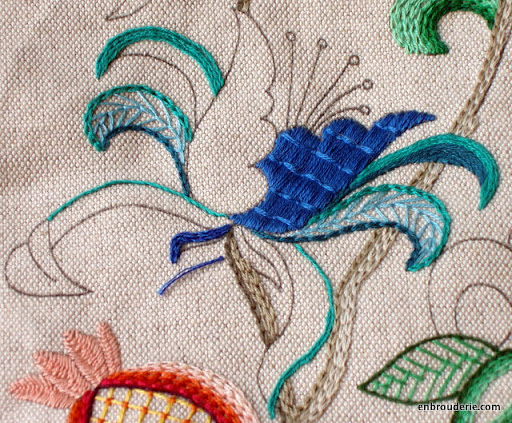
There’s another blue flower on the bellpull, and I decided to replace the long-and-short filling with Castelo Branco stitch on this flower too.

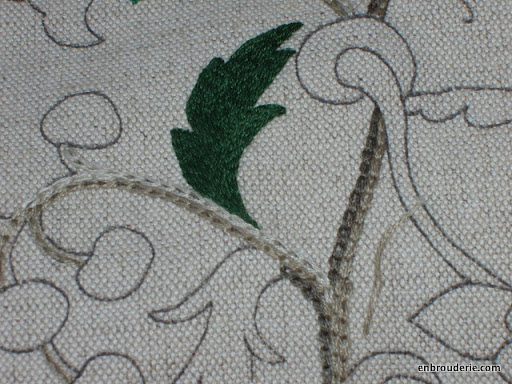
Then I replaced long-and-short stitch filling for this leaf with split stitch. I like the texture. It took a while to fill the leaf, though.

I started work on a new section at the top of the bellpull. I like the long and short stitch at the bottom right. It’s not that I’m trying to avoid long-and-short stitch! It’s beautiful for shading. But I wanted to try out some other filling stitches.

I have developed a new appreciation for chain stitch during this project. I love this leaf.

Posted in Crewel, My work | Tagged , , , , | 6 Comments

Castelo Branco Bird

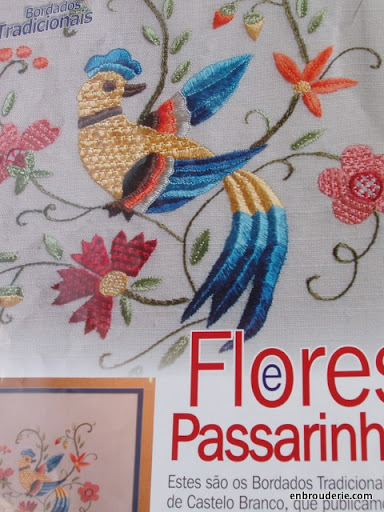
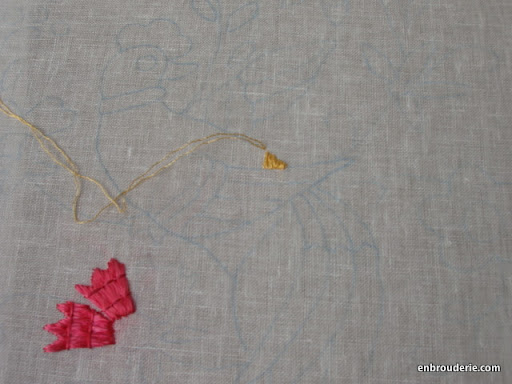
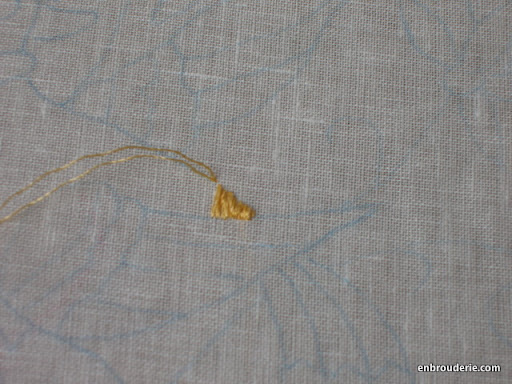
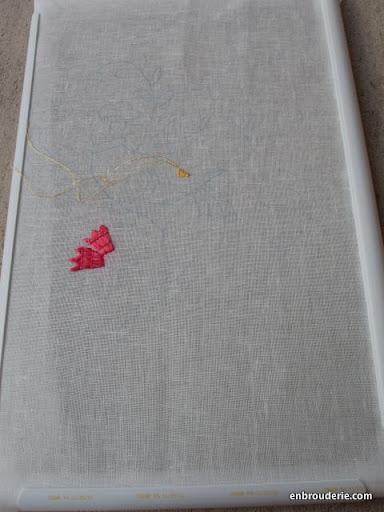
I’m starting a new project! (post with an overview of Castelo Branco embroidery). I am working this bird design from the Castelo Branco magazine Méri sent, using the Portuguese silk and rayons she sent (previous post on the lovely gifts from Portugal). Here is my progress so far:

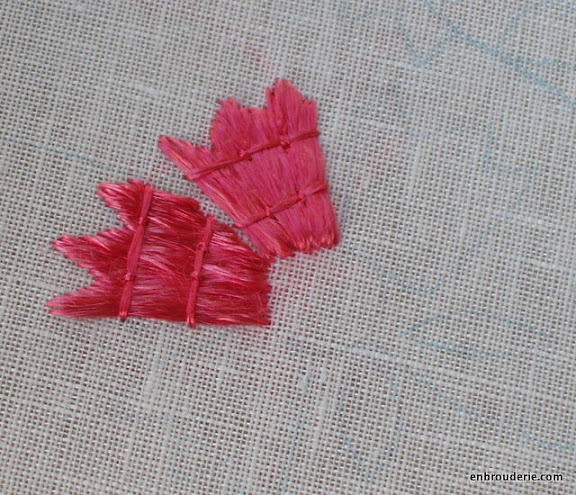
I worked two petals on this flower. I’m doing it in pink because I have more of that color available). Isn’t it pretty? I’m still working on my stitching. The thread is some kind of rayon, with lots of strands and a strong predilection for frizzing. It’s giving me a some trouble. The results are beautiful though, so I’m excited about the project.

I don’t have any yellow threads but I like the cheerful yellow color of the bird in the picture.  I’m trying to work out what a good thread available in the US would be. I’ve started here with some kind of rayon I think, but it’s definitely not a match. It’s not fluffy enough, and has only two strands. I have a little Pearsall’s silk but I’m not sure that’s  a match either. I will have to try again. Maybe another kind of rayon. It reminds me a little of Chinese silk.

In other news, I have discovered Q-snap frames. These are great! Easy to use, cheap, and they don’t crumple my fabric like hoops do.

Posted in Castelo Branco, My work | Tagged , , | 11 Comments

Tapestry

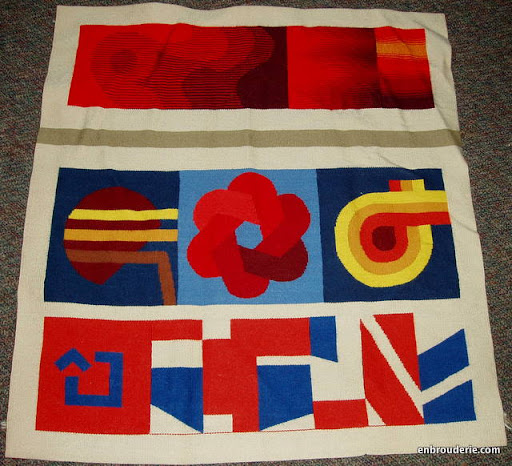
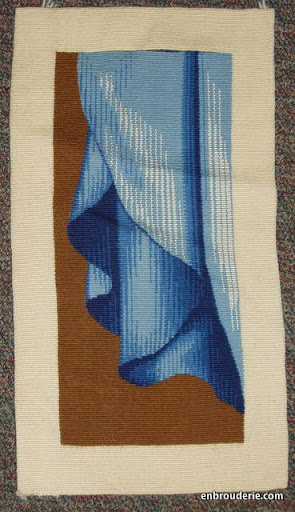
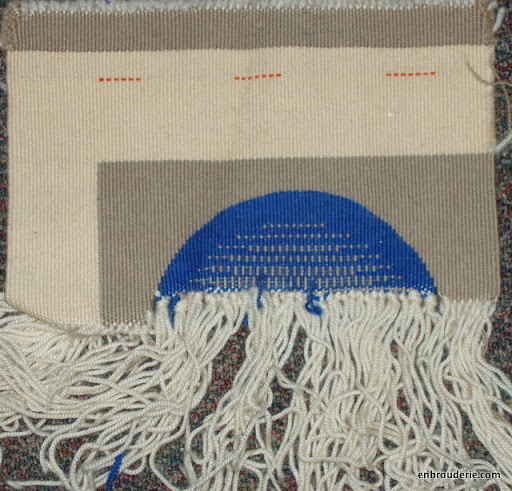
This post is slightly off topic for an embroidery blog, but I found it interesting so y’all will be learning about tapestries today. My mother did an internship many years ago (full-time, for a total of a year and a half) with the National Tapestry Works in Paris, France (Manufacture des Gobelins) to learn traditional weaving techniques. This post will cover exercises assigned to students.

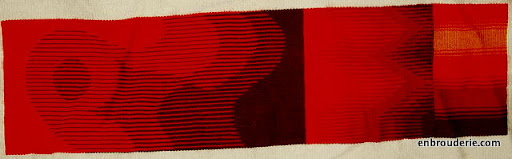
This tapestry is the first exercise given to students at the school. It’s like a sampler for new embroidery students. The difficulty increases from bottom to top. The first row is learning to weave straight lines and diagonals; the middle row introduces curves. The top row practices shading techniques. Perhaps some of it could be adapted to long-and-short stitch work for needlepainting.

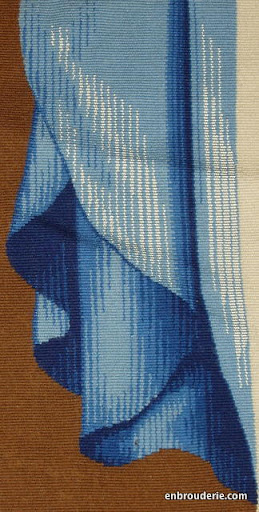
Here is an exercise in shading draperies according to the old-school method. The highlights are done in silk – the rest in wool. Crewel embroidery in wool sometimes uses silk highlights, too.

In comparison, the following exercise in more modern shading methods for tapestries relies more on dots and dashes than in long lines for shading.

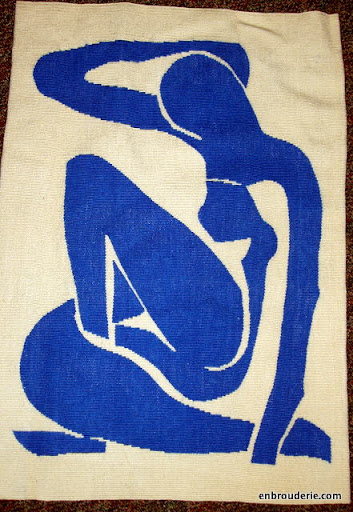
The tapestry below is based off of a work by Matisse. Students were assigned projects to address their weakest areas. This project required meticulous and detailed work, since any deviation from the curves is instantly visible. Other students (whose work was very careful) were assigned projects that required a far more freestyle approach.

Posted in Mother | 6 Comments

Continuing work on the crewel bellpull

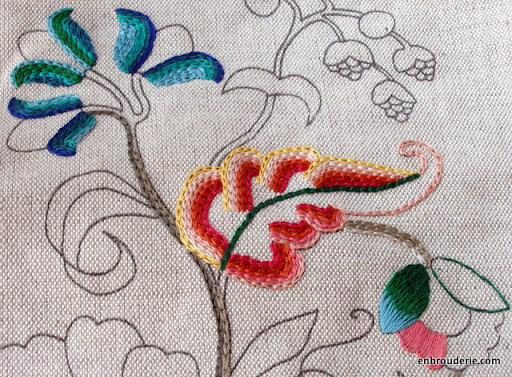
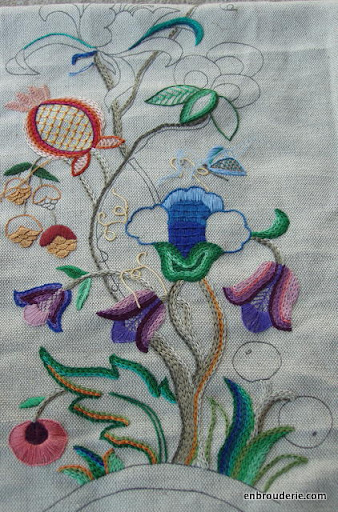
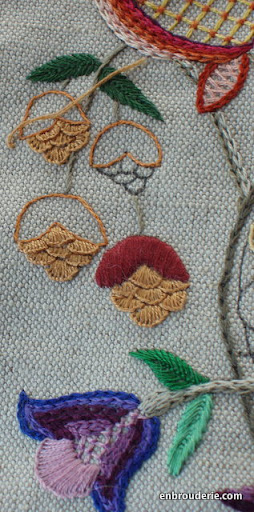
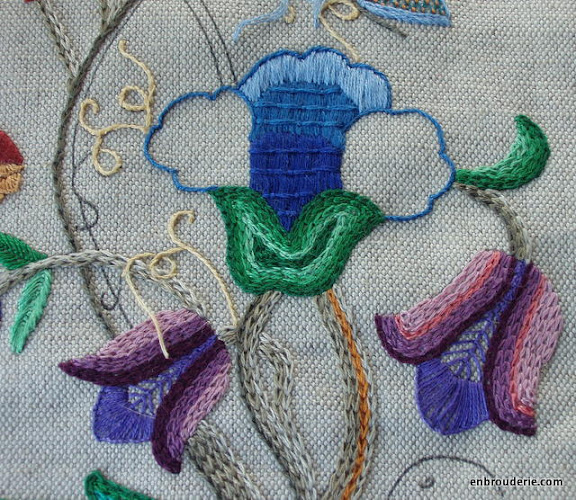
This bellpull is just gorgeous. It’s really coming along. Here’s a closeup of the area I was discussing in the last post on the bellpull (I’ve added some leaves in fly stitch, and finished one of the cluster flowers):

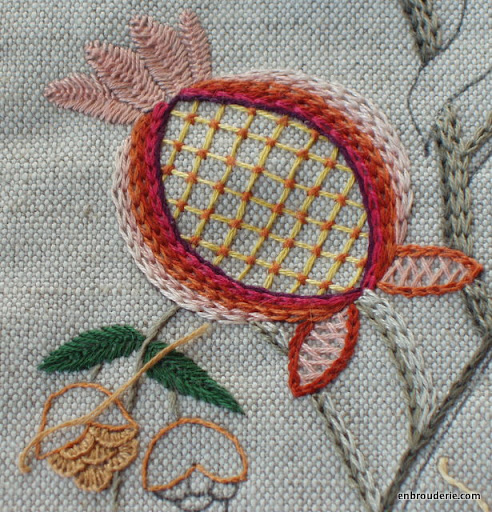
I finished the pomegranate top with cretan stitch. You can compare it with the fly stitch leaves below.

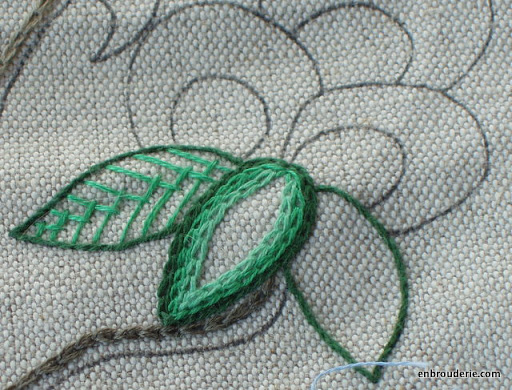
In the leaf on the left below I was aiming for a leaf stitch from my stitch guide, but didn’t read the directions carefully enough to match the diagram. I like the effect though, so I’ll be duplicating whatever this is on the right leaf.

I decided to fill in the center of this blue flower with Castelo Branco laid work stitching. I’m still planning to do a Castelo Branco project with the lovely silks and designs Méri sent me, so I thought I’d get a little bit of practice in.

This post has been brought to you with considerable enthusiastic help from my embroidery partner:

Posted in Crewel, My work | Tagged , , , , | 9 Comments

Candlewicking pillow

My grandma made this candlewicking pillow about 25 years ago. It’s a little hard to photograph since candlewicking is traditionally white-on-white, but the closeup photo is a little easier to see. The design shows a girl holding a bouquet.

The fundamental stitch is the colonial knot. Many embroidery patterns can be adapted to candlewicking by just covering the lines with evenly spaced colonial knots. It creates a very textured surface.

Posted in Candlewicking, Grandma | Tagged , , | 5 Comments

Suzanis from Uzbekistan

My aunt and uncle picked up this traditional embroidered wall hanging while visiting the Emir’s Summer Palace in Bukhara, Uzbekistan. It’s called a suzani.
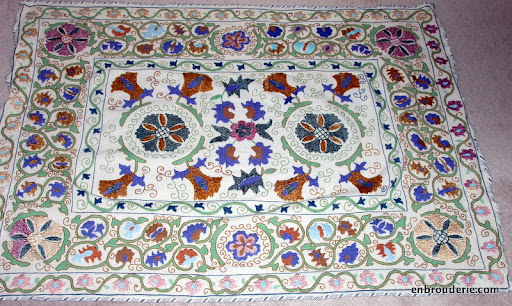
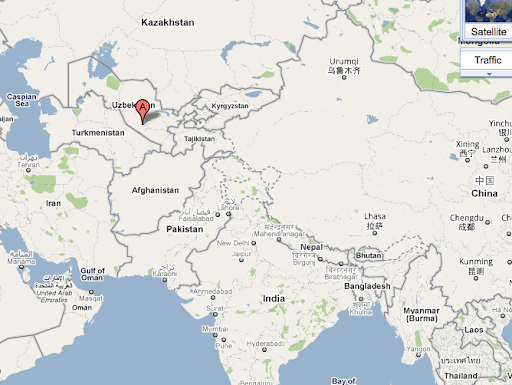
Below is a map with Bukhara, Uzebkistan marked (I was a little vague on exactly where Uzbekistan is myself). My aunt and uncle told me it was one of their more memorable vacations, and they’ve been on some really memorable vacations. It’s now on my list of places to visit someday.
I found an excellent article by Maria Mallet about suzanis:

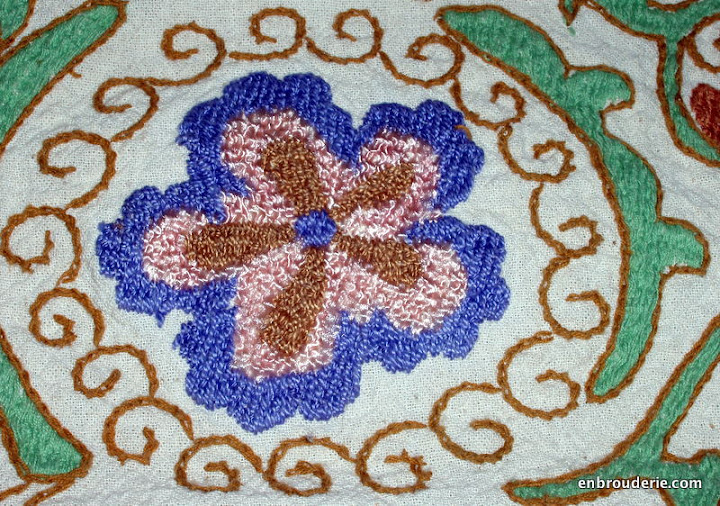
“The suzani embroidery threads are silk.  Two traditional stitches are used in a majority of the pieces:  primarily basma stitch, sometimes called Bukhara couching, and less often, chain stitch … Chain stitch is normally done with a fine tambour hook that’s much like a tiny crochet hook.  A suzani may be worked entirely with chain stitch, or the technique may be combined with basma couching.  Chain stitch is most often used for outlining couched areas or for producing delicate linear elements and fine details.” (Suzanis from Uzbekistan)

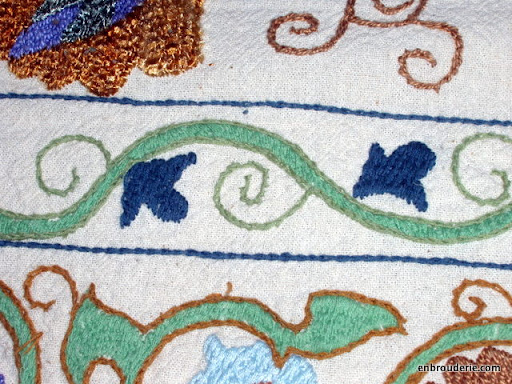
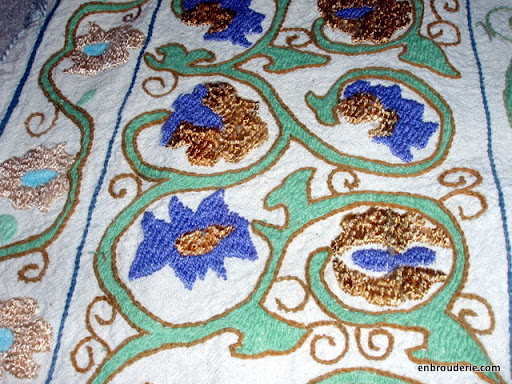
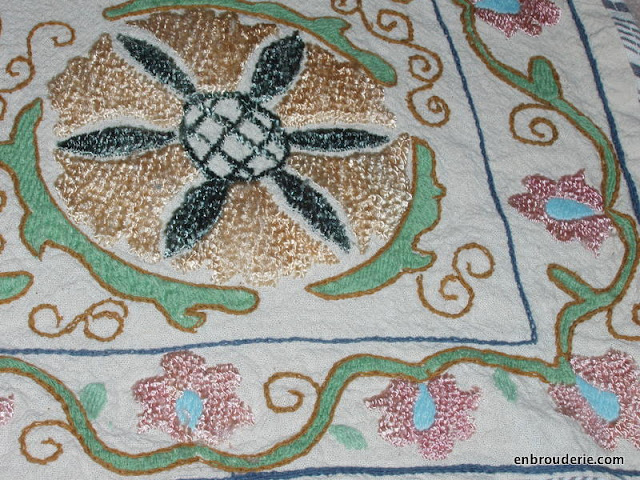
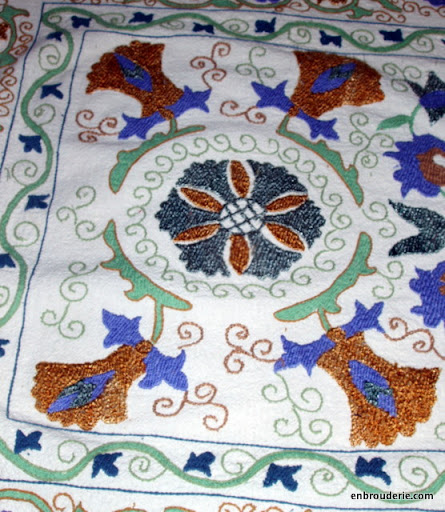
Here are a few a closeups of the wall hanging, where you can see exactly that (though I don’t know whether this one is silk or not):
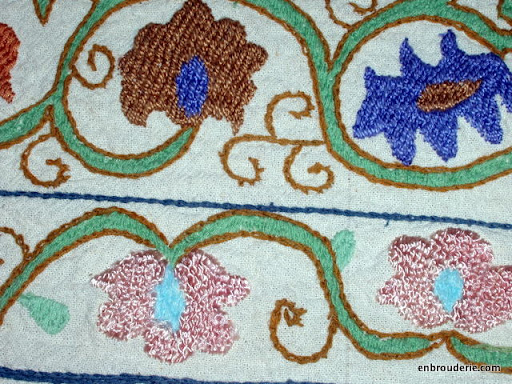
Fortunately for us, Mary Corbet has written a whole post about Bukhara couching, plus a video tutorial. Personally, I’m thinking hard about how to incorporate some Bukhara couching into my current embroidery pieces. It’s really lovely.

Something interesting about this particular wall hanging: there are a couple of spots where the embroiderer seems to have run out of thread halfway through a motif and switched colors.
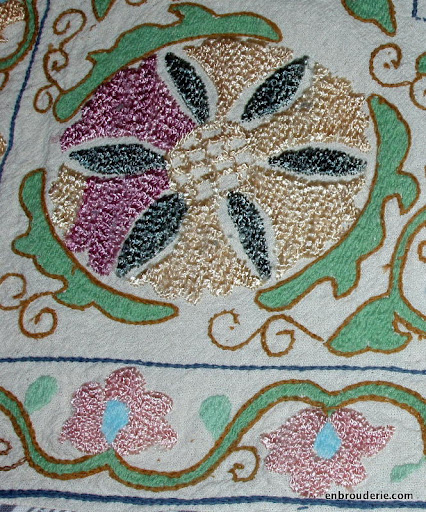
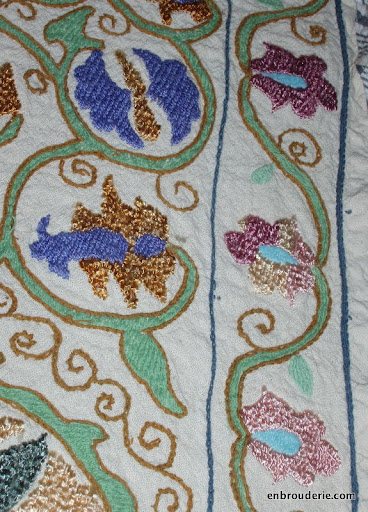
Flowering vine motifs are very common in suzanis. For additional reading on history and common motifs in suzanis, you can check out the article Splendid Suzanis by Caroline Stone.

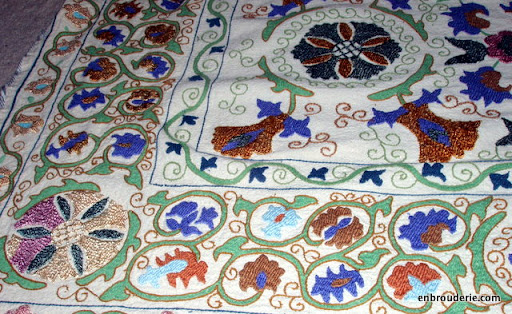
Now, I took a ton of photos of the suzani. It’s absolutely gorgeous in person. In hopes of conveying at least some of its beauty, I’m going to finish the post with a pile of extra photos.
Posted in Embroidery around the world | Tagged , , , | 2 Comments